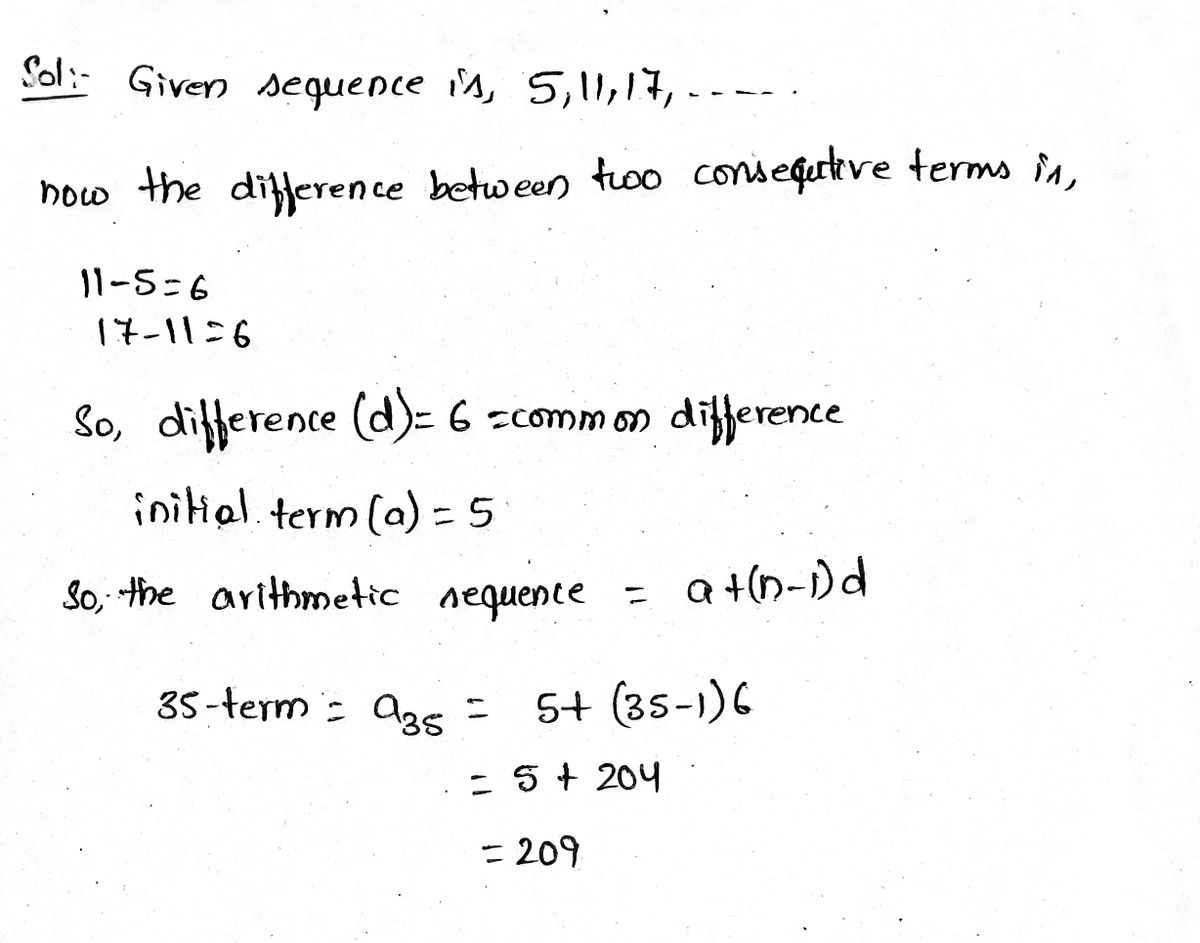
Hey there, math explorers and curious minds! Ever stumbled upon a pattern and wondered, "What's next?" You know, like when you see a line of dominoes waiting to fall, or the way the price of gas seems to always go up by a little bit each week? Well, today we're diving into something super neat that taps into that very same feeling: finding a specific term in an arithmetic sequence. Sounds fancy, right? But trust me, it's way more fun and approachable than it sounds. Think of it like a treasure hunt, but the treasure is a number, and the map is a simple rule.
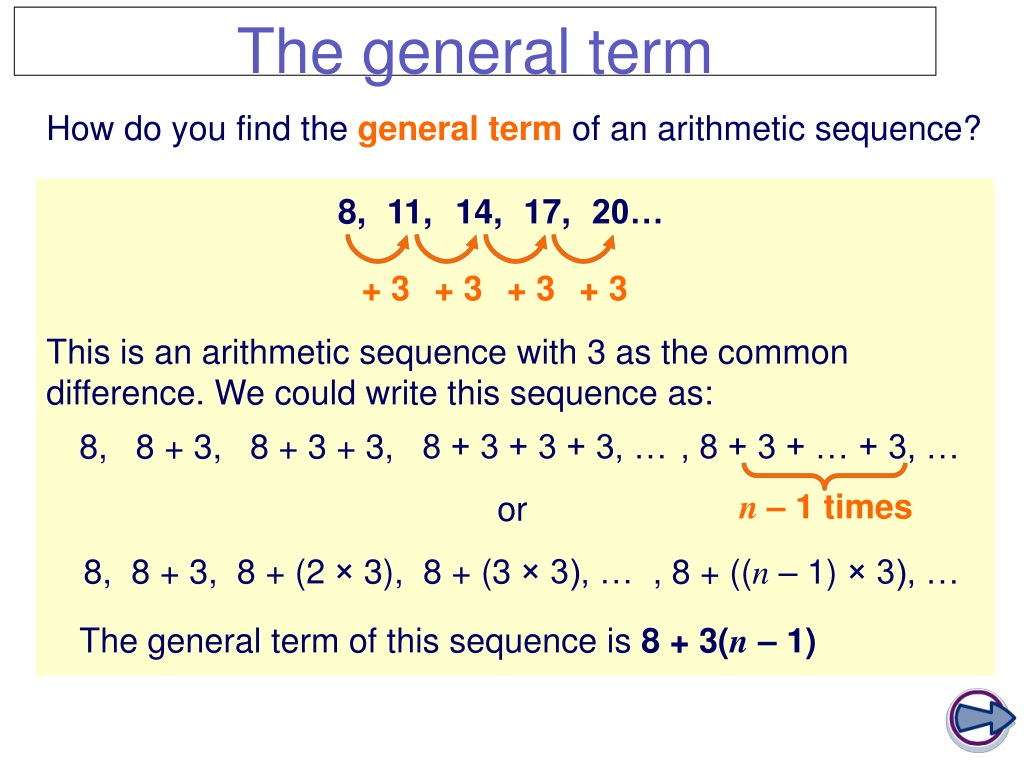
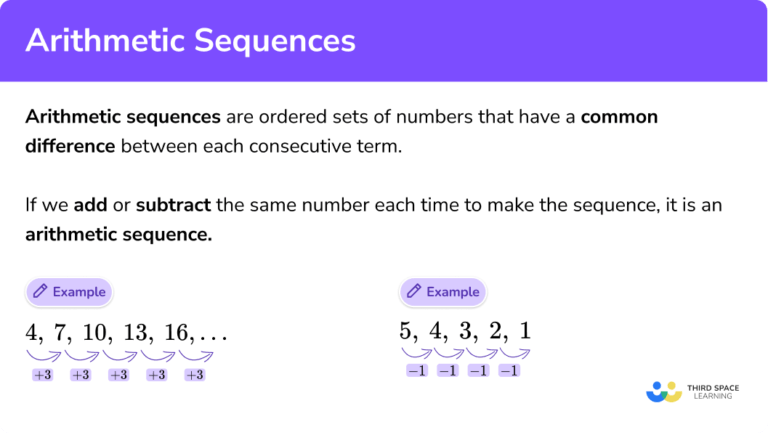
So, what exactly is an arithmetic sequence? Imagine you're collecting cool rocks. You start with 5 rocks, then you find 7, then 9, then 11. See that pattern? You're adding 2 more rocks each time. That consistent "add-on" is the magic ingredient for an arithmetic sequence. It's like a steady heartbeat, a predictable rhythm. Each new number in the sequence is found by adding the same value, called the common difference, to the previous one.
Let's break it down with a super simple example. Think about a staircase. If each step is the same height, say 6 inches, then the heights of the tops of each step form an arithmetic sequence: 6 inches, 12 inches, 18 inches, 24 inches, and so on. The first step is 6 inches (that's our starting point). The second step is 6 + 6 = 12 inches. The third is 12 + 6 = 18 inches. The common difference here is a consistent 6 inches.
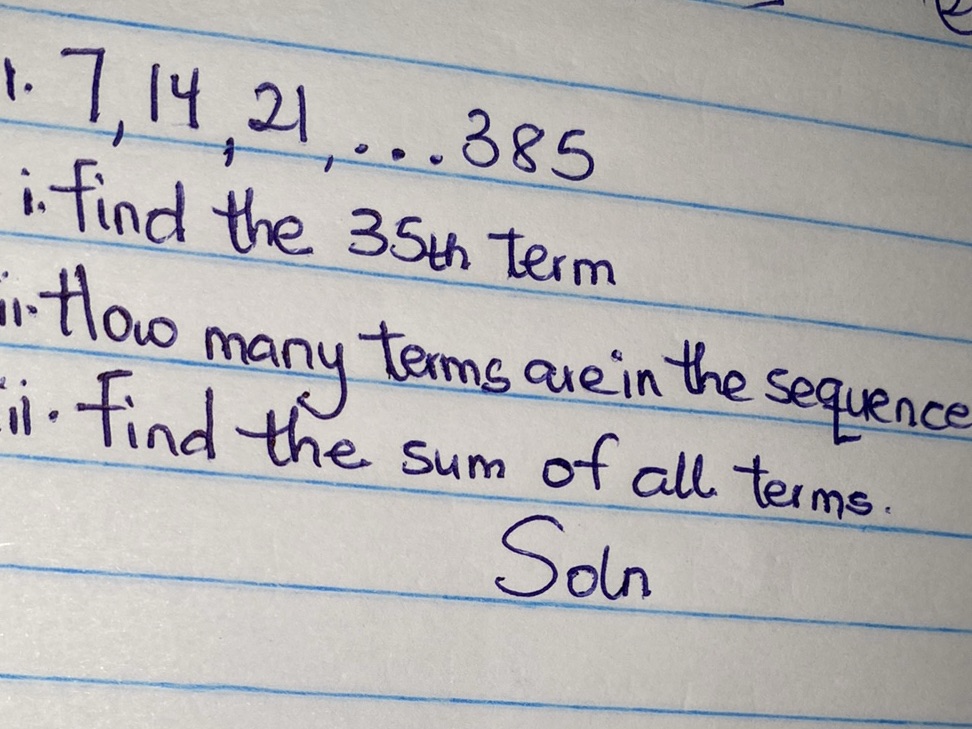
Now, imagine you're building a super tall tower, and you want to know the height of the 35th floor. If you know the height of the first floor and how much each floor adds (the common difference), you could technically just keep adding and adding until you get to the 35th. But who has that kind of time? That's where the cool math kicks in! We have a shortcut, a secret formula, that lets us jump straight to our answer without all the tedious counting.
The Secret Formula: Your Arithmetic Shortcut!
This is where the real fun begins. Instead of painstakingly calculating each term, we have a formula that's like a magic wand for arithmetic sequences. It's designed to help you find any term, no matter how far down the line it is. Think of it like having a super-fast car when you need to travel a long distance, instead of walking.
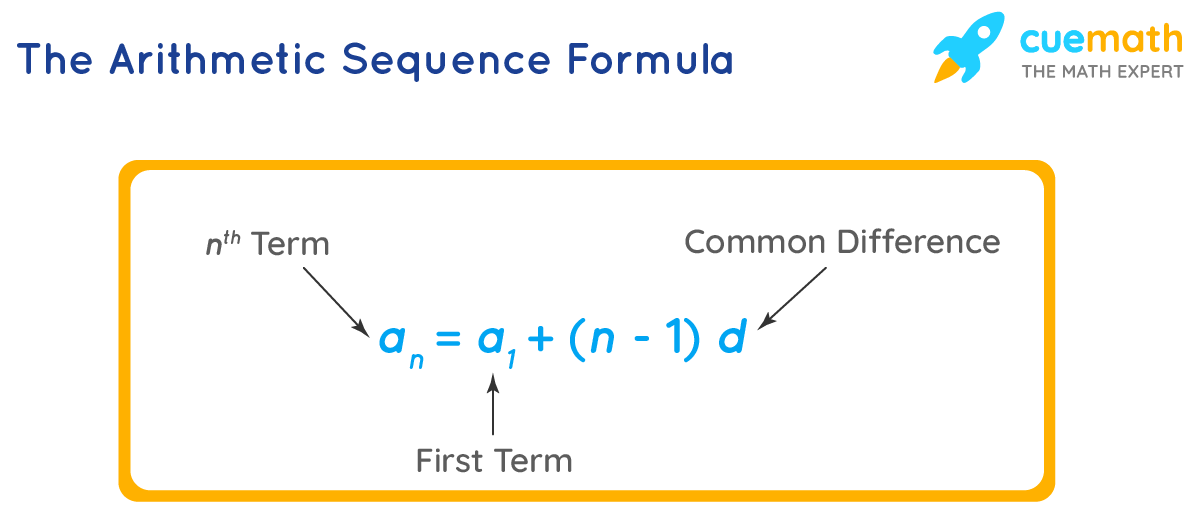
The formula looks a little something like this: an = a1 + (n - 1)d.
Whoa, hold on! Don't let the letters scare you. Let's decode this together.
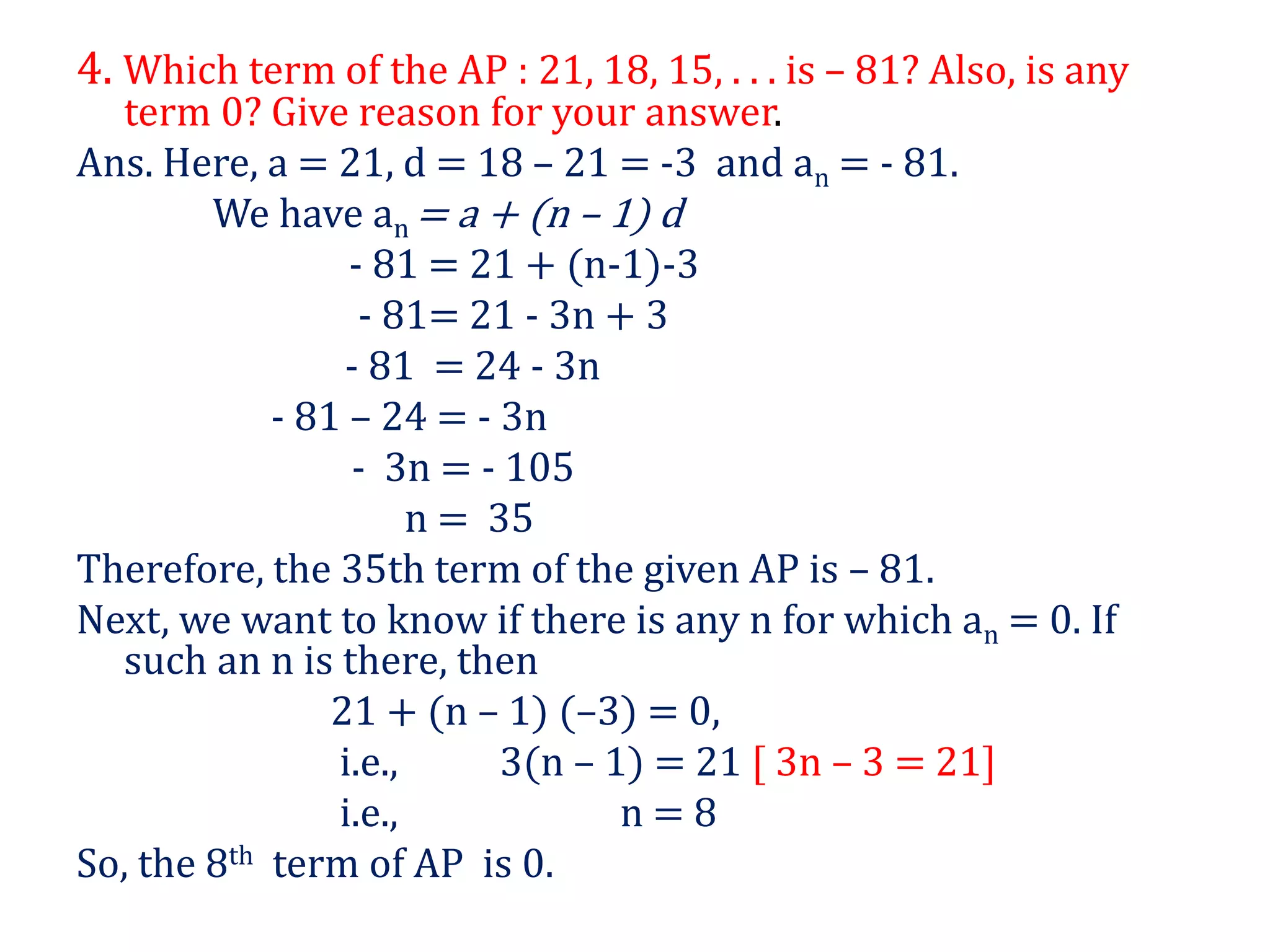
- an: This is simply the term you want to find. In our case, we're looking for the 35th term, so 'n' will be 35.
- a1: This is the very first term in your sequence. It's your starting point, your initial number.
- n: This is the position of the term you're interested in. So, for the 35th term, n = 35.
- d: And this, my friends, is the common difference. It's that consistent number you add each time to get to the next term.
See? Not so scary after all! It's just a way of organizing the information you already have (or can easily find) to get to the number you're looking for.
Let's Put It to the Test: Finding the 35th Term!
Okay, let's imagine a specific arithmetic sequence to make this concrete. Say we have a sequence that starts with 3, and the common difference is 5. So, our sequence looks like: 3, 8, 13, 18, 23, and so on. It's like a treasure chest that keeps getting 5 more gold coins added to it every day!
Now, we want to find the 35th term. Which term are we looking for? That's right, n = 35.
What's our starting point? The first term, a1 = 3.
And what's that consistent number we're adding? The common difference, d = 5.
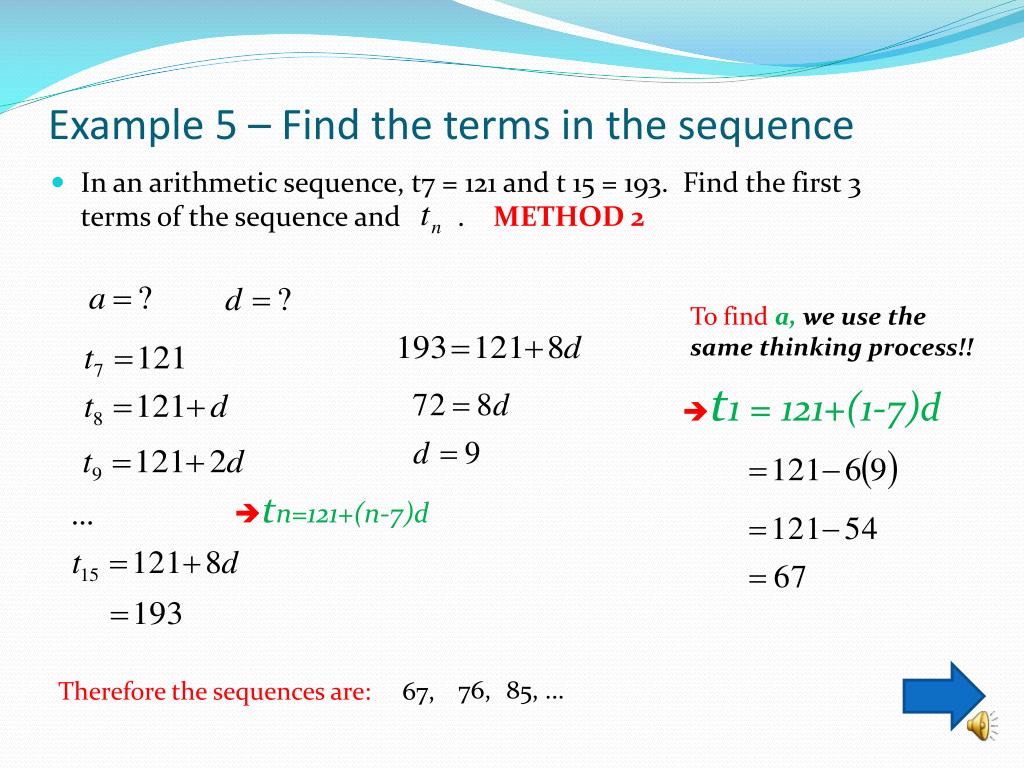
Now, let's plug these numbers into our formula:
a35 = 3 + (35 - 1) * 5
First, let's sort out what's inside the parentheses. 35 minus 1 is 34. So our formula becomes:
a35 = 3 + (34) * 5
Next, we do the multiplication. 34 times 5. If you're thinking 30 times 5 is 150, and 4 times 5 is 20, then 150 + 20 = 170. So, 34 * 5 = 170. Our formula now is:

a35 = 3 + 170
And finally, the addition! 3 plus 170 gives us a whopping 173!
So, the 35th term in our arithmetic sequence (starting with 3 and adding 5 each time) is 173. Pretty neat, huh?
Think about it: if we had to list out all 35 terms by just adding 5 each time, we'd be here all day! This formula saved us a ton of work and potential mistakes. It's like having a calculator for patterns.
Why Is This So Cool?
Beyond just solving a math problem, understanding how to find terms in arithmetic sequences is like unlocking a new way of seeing the world. It shows up in all sorts of places, sometimes where you least expect it.

Imagine a farmer planting trees in rows. If they plant 10 trees in the first row, and then 12 in the second, 14 in the third, and so on, that's an arithmetic sequence! If you wanted to know how many trees were in the 50th row, you could use our formula. It's about predicting and understanding growth or progression.
Or think about saving money. If you save $10 this week, $20 next week, $30 the week after, you're creating an arithmetic sequence of your savings! The 35th week's savings? You can figure that out in a snap!
It’s a fundamental concept in mathematics, a stepping stone to understanding more complex patterns and functions. It’s the bedrock of predicting how things change in a consistent, predictable way. It helps us model real-world situations, from financial planning to scientific observations.
So, the next time you see a sequence of numbers, don't just see numbers. See a pattern. See a rhythm. See a potential for prediction. And remember, with a little bit of formula magic, you can find any term you desire, no matter how far down the line it might be!
Keep exploring, keep questioning, and keep finding those fascinating patterns in the world around you. Happy calculating!