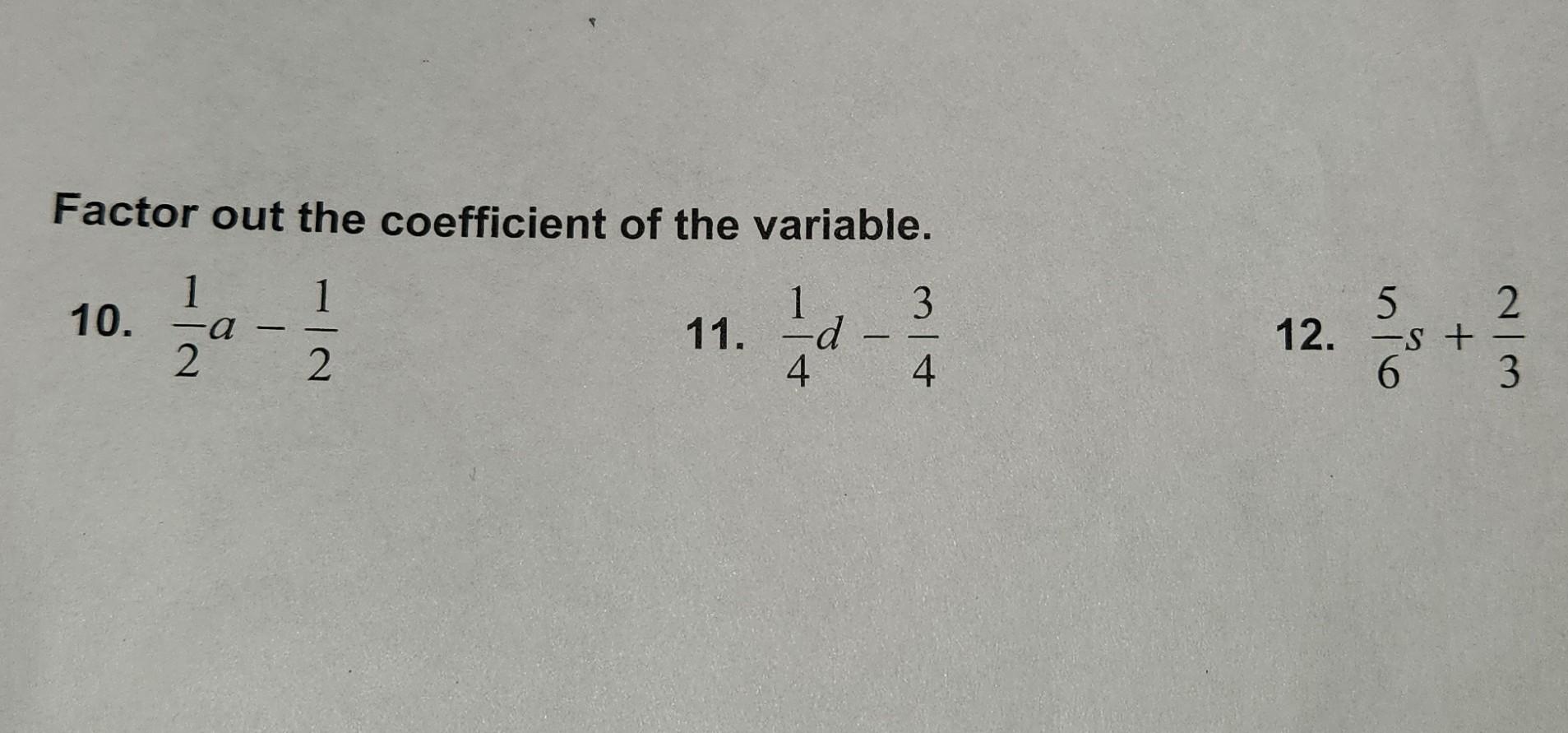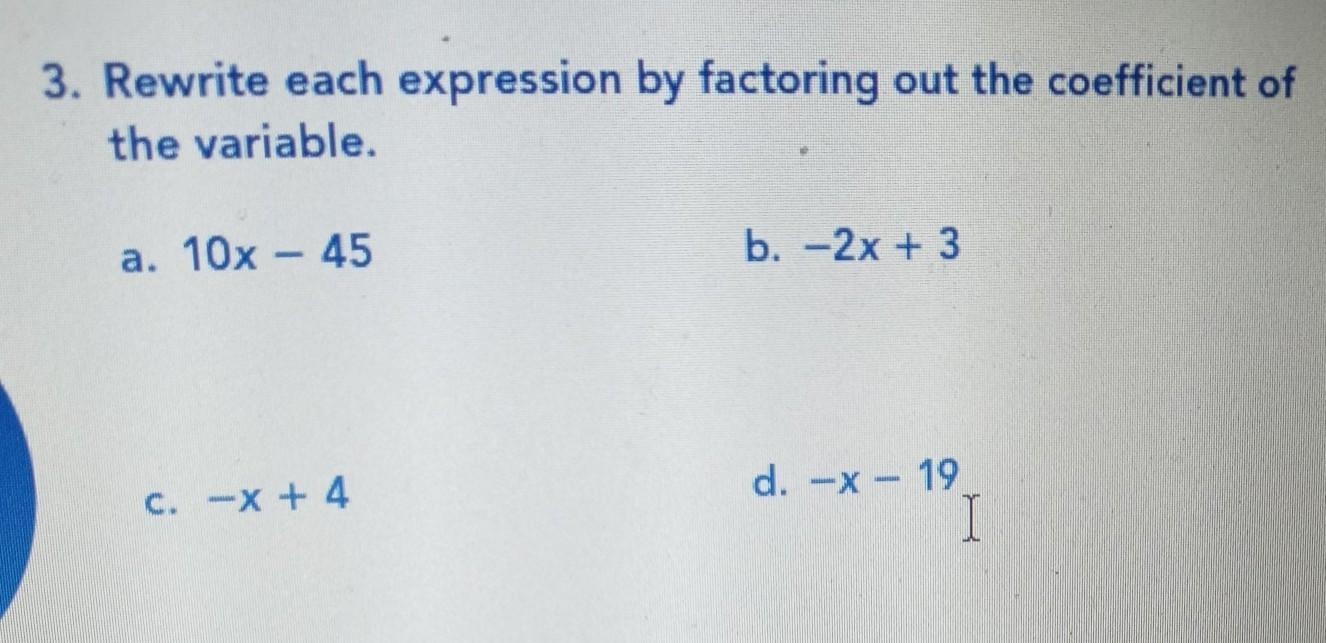
Hey there, math adventurer! Ready to dive into a super cool, yet surprisingly simple, math trick? Today, we're talking about "factoring out the coefficient of the variable." Sounds fancy, right? But honestly, it's like giving your equation a little makeover, a bit of a tidy-up, to make things much, much easier to handle. Think of it as decluttering your math workspace!
So, what exactly are we talking about here? Well, imagine you've got an equation that looks a little… crowded. Maybe it's something like 4x + 8 = 12. Notice that 4 and the 8? They've got a little something in common, a shared guest at their mathematical party. And that shared guest is our friend, the number 4! This is where factoring out the coefficient comes in, like a polite maître d' showing everyone to their designated table.
Let's break down the lingo, because "coefficient" can sound a bit intimidating. In an expression like 4x, the 4 is the coefficient. It's the number that's chilling out right in front of the variable (that's our 'x' friend, always doing its thing). The variable is the part that can change, like a chameleon blending into different numbers. The coefficient is its trusty sidekick, multiplying it.
Factoring out the coefficient of the variable is basically saying, "Hey, this number is multiplied by everything inside these parentheses. Let's pull it out and see if that simplifies things." It's like having a group of friends who all want to go to the same movie, so instead of everyone buying their own ticket individually, one person buys a block of tickets for the whole crew. Much more efficient, right?
Let's take our little example: 4x + 8 = 12. Our variable is 'x', and its coefficient is 4. Now, look at the other term, the '8'. Can 8 be divided by 4? You betcha! Since both 4x and 8 share a factor of 4, we can "factor out" that 4. What does that mean in practice? Well, we're essentially saying: "Okay, 4 is a common factor here. Let's write it outside the parentheses."
So, 4x + 8 can be rewritten as 4(x + 2). See what happened? We took out the 4. Inside the parentheses, we have what's left after we "undivied" each term by 4. For 4x, taking out the 4 leaves us with just 'x'. For 8, taking out the 4 leaves us with '2'. And voilà, 4(x + 2)!
Why would we even bother doing this? Great question! Sometimes, this simple act can make solving equations a piece of cake. Let's go back to our equation: 4x + 8 = 12. If we factor out the 4, we get 4(x + 2) = 12. Now, check this out. To get rid of that big '4' hanging out in front, what can we do? We can divide both sides of the equation by 4!
So, 4(x + 2) / 4 = 12 / 4. That simplifies beautifully to x + 2 = 3. See how much simpler that is? Now, to isolate our 'x', we just need to subtract 2 from both sides. And bingo! x = 1. That was way easier than trying to deal with the 4x and 8 directly, don't you think?

This technique is especially handy when you have coefficients that aren't so… friendly. Imagine something like 6x + 15 = 21. Our variable is 'x', and its coefficient is 6. Now, look at 15. Can 15 be divided by 6? Nope, not evenly. But wait! Do 6 and 15 share any common factors? Let's think about their multiplication buddies.
Multiples of 6: 6, 12, 18, 24… Multiples of 15: 15, 30, 45…
Hmm, no common factors other than 1. Okay, scratch that. Let's check their factors: Factors of 6: 1, 2, 3, 6 Factors of 15: 1, 3, 5, 15
Aha! They share a common factor of 3! So, we can factor out the 3 from both terms. 6x + 15 becomes 3(2x + 5). And the equation is now 3(2x + 5) = 21. Again, we can divide both sides by 3. So, 2x + 5 = 7. Now, subtract 5 from both sides: 2x = 2. And finally, divide by 2: x = 1. Pretty slick, huh?
It's all about finding the greatest common factor (GCF). The GCF is the biggest number that can divide into all the numbers you're looking at. In 4x + 8, the GCF of 4 and 8 is 4. In 6x + 15, the GCF of 6 and 15 is 3. Finding the GCF is your superpower for this trick!

Let's try another one, just for fun. How about 9y - 27 = 36? Our variable is 'y', and its coefficient is 9. Now, let's look at 27. Can 27 be divided by 9? Yes, it can! 27 divided by 9 is 3. So, the GCF of 9 and 27 is 9. We can factor out the 9.
9y - 27 becomes 9(y - 3). The equation is now 9(y - 3) = 36. To make things easy, we divide both sides by 9. That gives us y - 3 = 4. To get 'y' all by its lonesome, we add 3 to both sides. And there you have it: y = 7. Easy peasy lemon squeezy!
Sometimes, the coefficient of the variable might be negative. Don't let that scare you! It just means you're factoring out a negative number. For example, -5x + 10 = 15. The coefficient of 'x' is -5. Both -5 and 10 are divisible by -5. So, we can factor out -5.
-5x + 10 becomes -5(x - 2). Remember, when you divide a positive number by a negative number, the result is negative. So, 10 / -5 = -2. And to get the '-5x' back from '-5(x - 2)', we'd have -5 * x = -5x and -5 * -2 = +10. It works!
Our equation is now -5(x - 2) = 15. To get rid of that -5, we divide both sides by -5. So, x - 2 = 15 / -5, which is x - 2 = -3. To get 'x' by itself, we add 2 to both sides. x = -3 + 2, which means x = -1. See? Negatives are just numbers with a little more attitude!
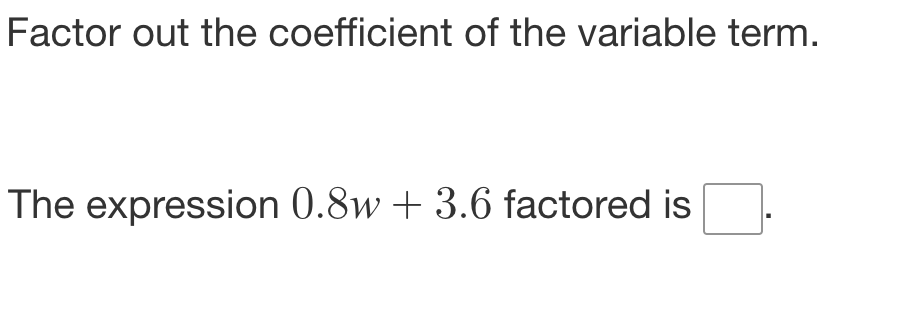
What if the coefficient of the variable isn't the only common factor? For instance, 12x + 18 = 30. The coefficient of 'x' is 12. Can 18 be divided by 12? Nope. But what are the common factors of 12 and 18?
Factors of 12: 1, 2, 3, 4, 6, 12 Factors of 18: 1, 2, 3, 6, 9, 18
The common factors are 1, 2, 3, and 6. The greatest common factor is 6. So, we can factor out the 6.
12x + 18 becomes 6(2x + 3). The equation is now 6(2x + 3) = 30. Divide both sides by 6: 2x + 3 = 5. Subtract 3 from both sides: 2x = 2. Divide by 2: x = 1. We still got a clean answer!
You might be thinking, "Can I just factor out the coefficient of the variable even if the other terms aren't divisible by it?" The answer is technically yes, but it might not be the most helpful step in solving. The real magic of factoring out the coefficient happens when it's a common factor that makes the numbers inside the parentheses simpler, or at least more manageable.
Think of it like this: you're packing for a trip. You could shove everything into one giant suitcase, but it would be a mess. Or, you could organize things into smaller bags (like factoring out a common number). It makes everything neater and easier to find. And when it comes to math, neatness and simplicity are your best friends!
This skill is a stepping stone to so many other cool math concepts. It's like learning to tie your shoelaces before you can run a marathon. Once you get the hang of factoring out coefficients, you'll find that many equations that looked like a tangled mess become much more organized and approachable.
The beauty of math is that there's often more than one way to solve a problem. But sometimes, a particular technique, like factoring out the coefficient of the variable, can be the key that unlocks a particularly elegant and straightforward solution. It’s like finding a secret shortcut on a treasure map!
So, the next time you see an equation with a number chilling out in front of your variable, and other numbers in the equation that seem to have a connection to that number, take a moment. See if you can spot that common factor. Pull it out, put it in its place outside the parentheses, and watch how the rest of the equation seems to sigh with relief and fall into place.
Remember, every math problem is an opportunity to learn and grow. And this particular skill? It's a little gem that will make your mathematical journey smoother and, dare I say, a bit more enjoyable. So go forth, factor with confidence, and remember that even the trickiest equations can be tamed with a little bit of cleverness and a smile! You've got this!