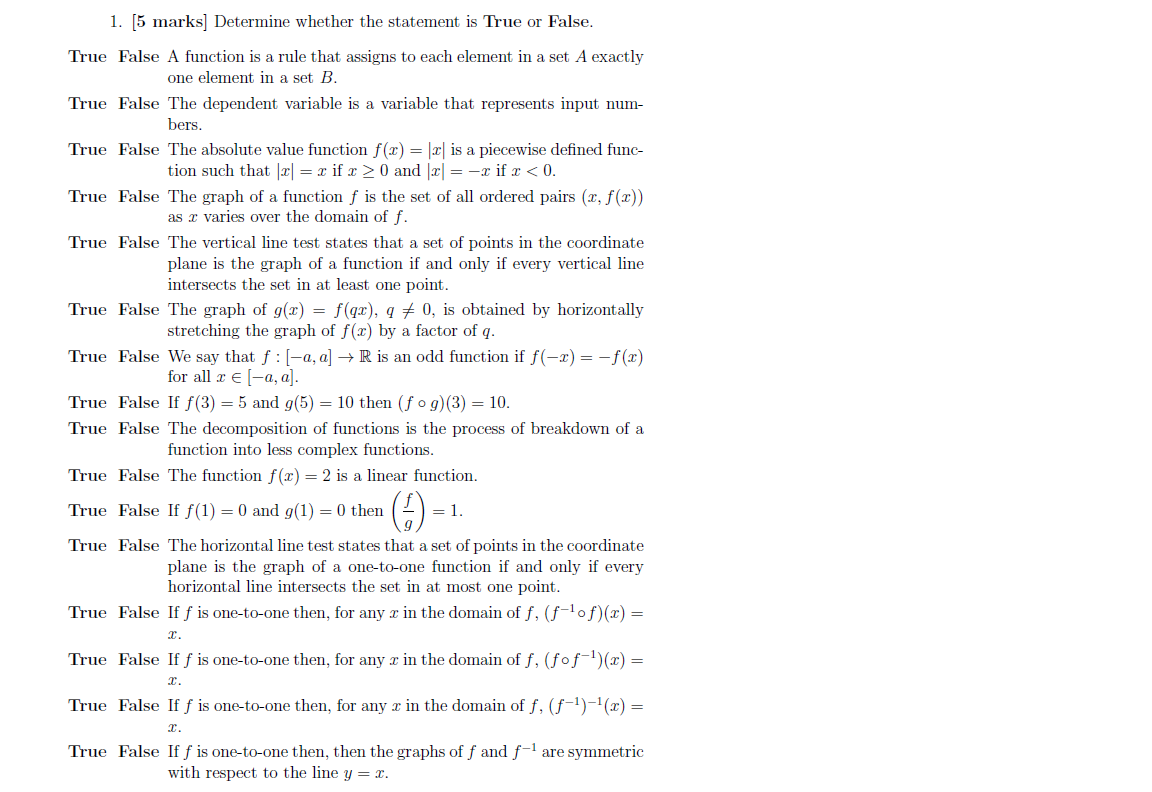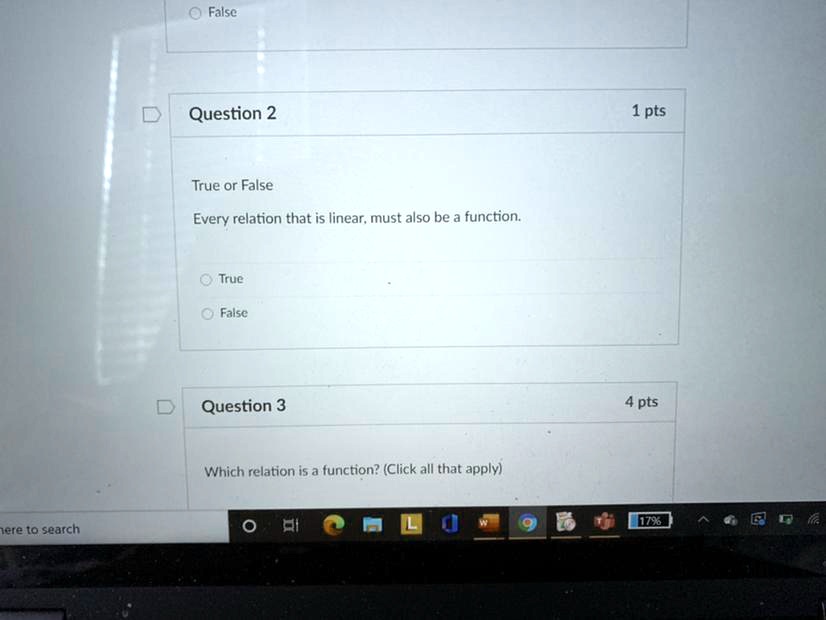
Alright, gather 'round, folks, and lend an ear! We're about to dive into a topic that sounds drier than a week-old croissant but is actually, I swear, a little bit like a detective story. We're talking about relationships. Not the messy, "who texted first?" kind, though those can be pretty complicated too. No, we're talking about mathematical relationships. And the big question of the day, the one that might keep you up at night (or at least make you tilt your head like a confused puppy), is this: Every relation is a function. True or False?
Now, before you start picturing awkward speed dating for numbers or a mathematical matchmaking service, let's break it down. What even is a relation in math? Think of it like a set of pairs. You know, like "peanut butter and jelly" or "socks and shoes." They just… go together. In math, we often write these pairs as ordered pairs, like (2, 4) or (apple, red). It's just saying that "2 is related to 4" or "an apple is related to red." Simple enough, right? We can have a whole bunch of these pairs hanging out together, forming our little mathematical clique, which we call a relation.
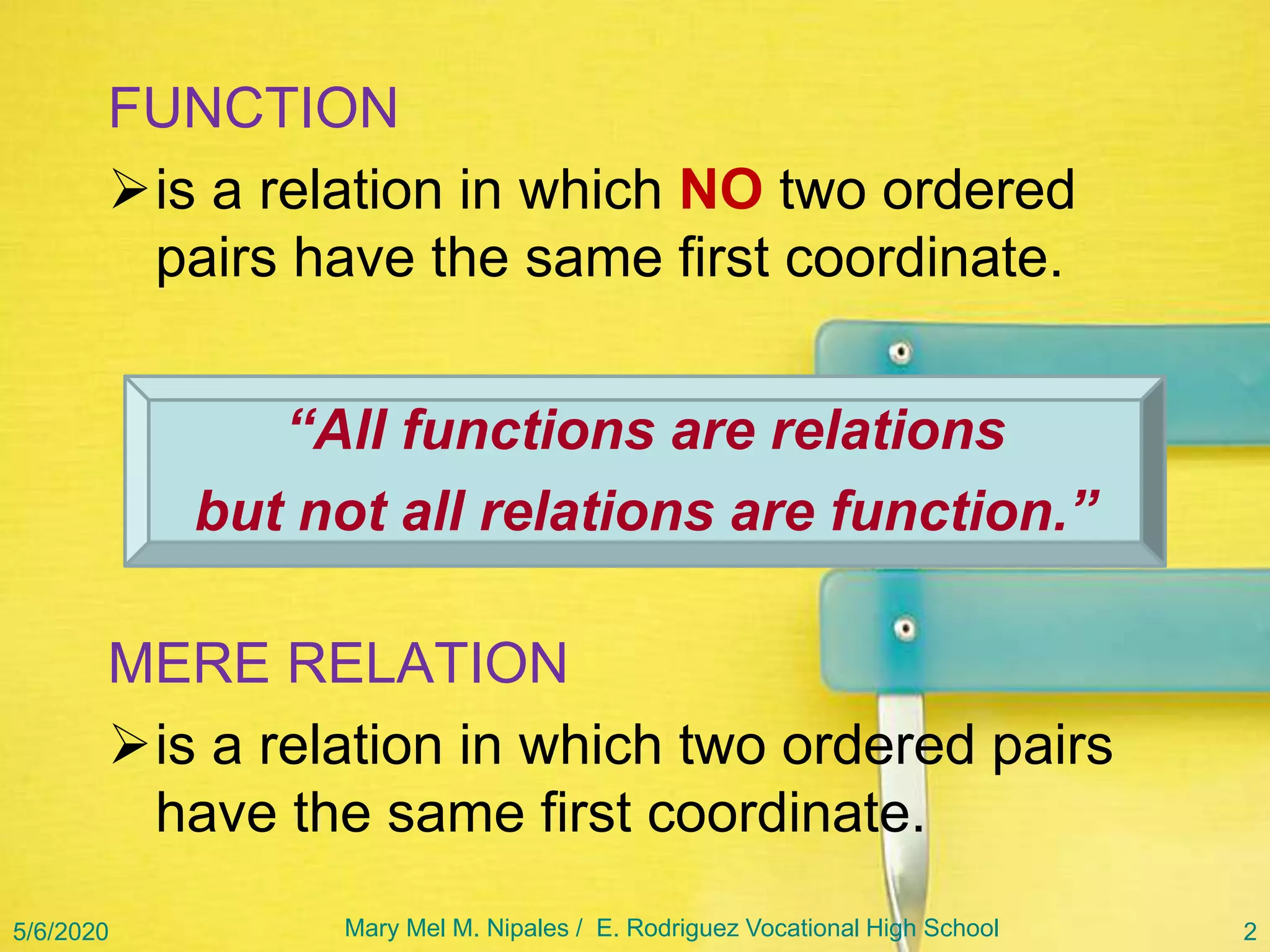
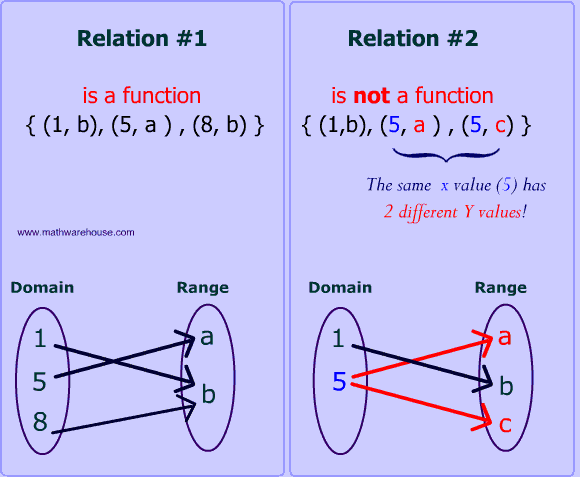
Now, a function. Ah, the function. This is where things get a smidge more exclusive. Imagine a bouncer at a super-trendy club. This bouncer has one very strict rule: each input can only have one output. Think of it like a vending machine. You put in a dollar (your input), and you expect to get one specific snack (your output). You don't want to put in a dollar and have a bag of chips, a candy bar, and a confused squirrel pop out, do you? That would be chaos! A function is the well-behaved, predictable vending machine of the math world.
So, let's go back to our grand question: Every relation is a function. True or False? My gut, and a healthy dose of mathematical experience, tells me this sounds a little too good to be true. It's like saying "every pet is a dog." Well, no, fluffy the cat would like a word with you. Or "every movie is a romantic comedy." My weekend plans would be very different if that were the case.
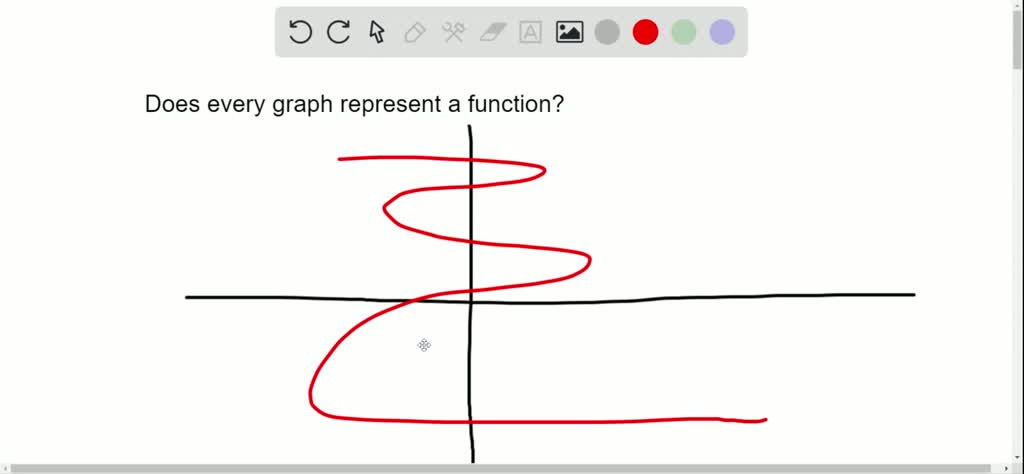
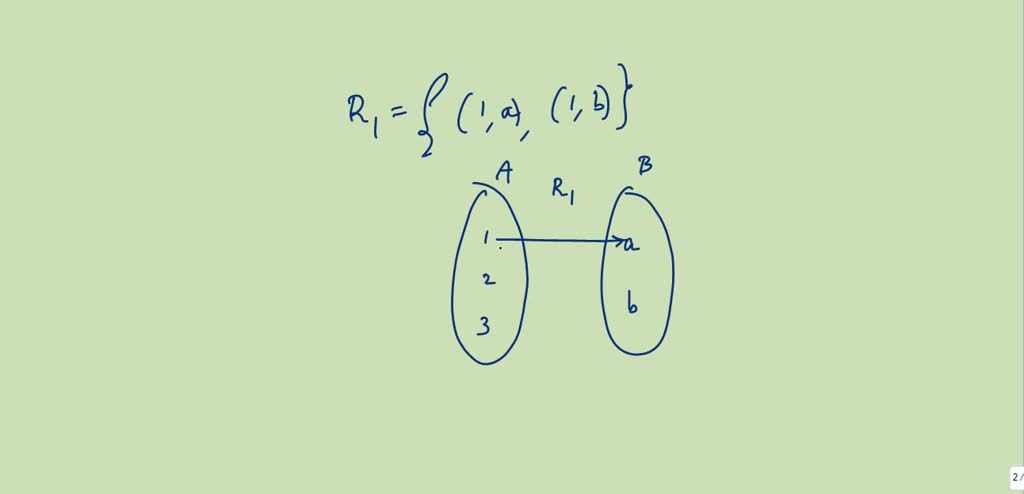
Let's whip out an example. Consider the relation: {(2, 4), (3, 6), (2, 5)}. See that little guy? The number 2 is paired up with both 4 and 5. Uh oh. This is where our trendy club bouncer (the function rule) would have a meltdown. The input '2' is trying to go to two different places! This relation, my friends, is not a function. It's like inviting your friend Bob to a party and then also sending Bob's evil twin, Bob-B, to the same party without telling anyone. Confusion ensues.
The key difference, the absolutely crucial, make-or-break, separating-the-wheat-from-the-chaff distinction, is that a function is a relation with a special superpower: no repeating inputs with different outputs. All the inputs are like well-behaved party guests who only show up once. The outputs? They can be a bit more social. They can be friends with multiple inputs. Think of the relation where your input is a person and the output is their birthday. You can have multiple people with the same birthday (hello, Gemini twins!), but each person only has one birthday. That's a function! A beautiful, organized function.
Let's try another one. Consider the relation: {(New York, USA), (London, UK), (Paris, France), (Beijing, China)}. Is this a function? Well, each city (input) is linked to exactly one country (output). New York has only one home country, London only one, and so on. So, yes, this relation is a function. It's like a perfectly organized travel brochure.

But what if we flipped it? Relation: {(USA, New York), (USA, Los Angeles), (UK, London), (France, Paris)}. Now, what's the deal? The input 'USA' is connected to both New York and Los Angeles. This is where our function rule screams, "Wait a minute! One input, two outputs? Nope, nope, nope!" This relation is not a function. It's like trying to ask your GPS for "the best restaurant in my city," and it gives you a list of 50 places. Helpful, maybe, but not a single, definitive answer like a function would provide.
So, to recap our little mathematical rendezvous: A relation is just a pairing of things. A function is a special kind of relation where each input is only ever paired with one output. It's like the difference between "people who like pizza" (a relation – many people like pizza, and one person might like many types of pizza) and "your favorite pizza topping" (a function – you have one favorite, even if you enjoy others too).
Why does this even matter, you ask? Well, functions are the backbone of so much of science, engineering, economics, and even just understanding how the world works. They allow us to model predictable systems. If we know how much you've studied (input), we can predict (within reason, of course, unless you're using a magic 8-ball for your grades) how well you might do on a test (output). That predictable relationship is often a function. If it wasn't, well, imagine trying to build a bridge where the amount of steel you use has a different effect on the strength every single time! Nightmare fuel.
Think of it this way: all squares are rectangles, but not all rectangles are squares. Similarly, all functions are relations, but not all relations are functions. The statement "Every relation is a function" is, therefore, a resounding FALSE. It's a common misconception, like thinking that all bears are cuddly teddy bears. (Spoiler alert: they are not.)
So, the next time you're presented with a set of pairs, whether they're numbers, cities, or even your questionable fashion choices from last year, you'll know how to spot a function. Just ask yourself: is any single input trying to pull a fast one and go on two different dates? If the answer is yes, then it's a relation. If the answer is a solid, unwavering no, then congratulations! You've found yourself a function. And in the wild world of mathematics, that's something to celebrate. Now, who's ready for more coffee and less math talk?