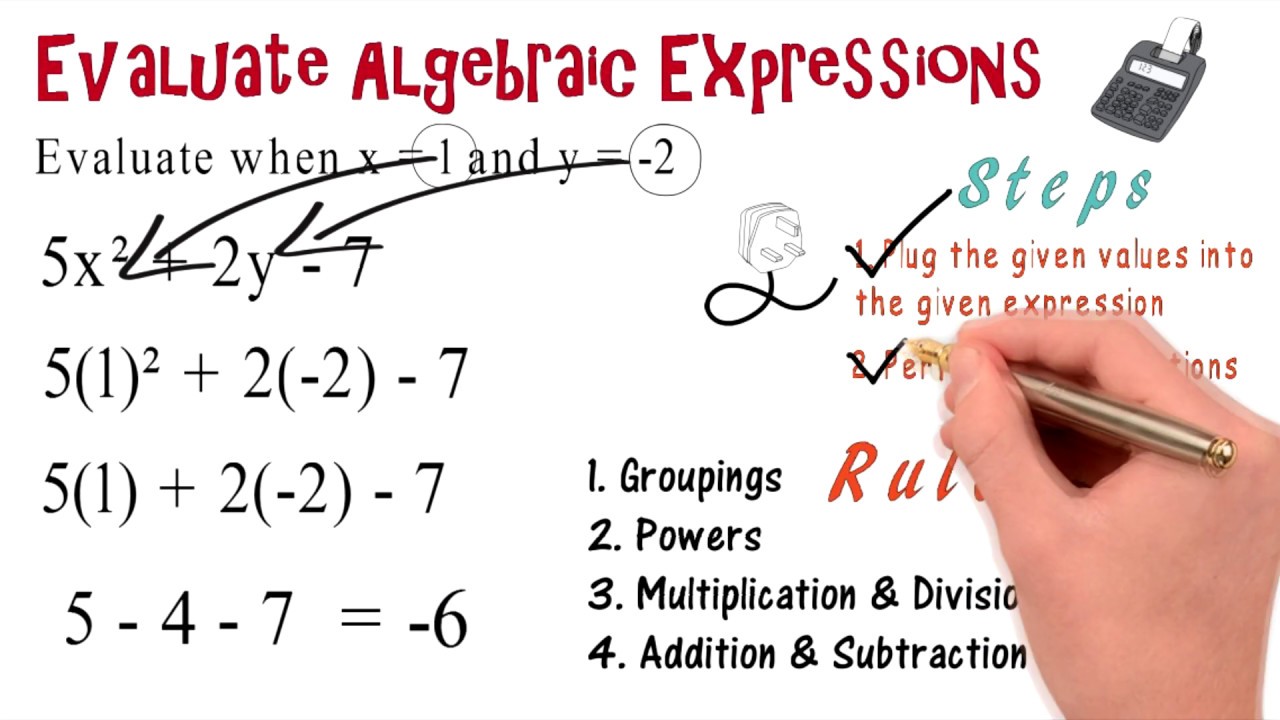
Hey there, math adventurer! So, you've stumbled upon a quest to… evaluate expressions? Don't worry, it's not as scary as it sounds. Think of it like decoding a secret message, or maybe just figuring out how many cookies are left after a raid on the cookie jar. We're going to break down what it means to "evaluate" and tackle a few examples together. No need to break out the calculator just yet – unless it's for bragging rights about how fast you can add 2+2. 😉
Basically, when we're asked to evaluate an expression, we're being asked to find its single, final value. Imagine you have a recipe that says "2 cups of flour + 1 cup of sugar." Evaluating that would be figuring out the total amount of dry ingredients, which is 3 cups. See? Not so bad!
Expressions are just mathematical phrases. They're made up of numbers, variables (those are like placeholders, think of them as little mystery boxes), and operations (like addition, subtraction, multiplication, and division). When we're given a specific value for a variable, poof! That mystery box is opened, and we can find the exact numerical answer.
Let's dive into some examples, shall we? We'll start with the super simple stuff and work our way up. Think of it as a warm-up for your brain. Ready?
The Basics: Just Numbers and Operations
Sometimes, expressions are just a straightforward combination of numbers and operations. No sneaky variables, no hidden agendas. Just pure, unadulterated math.
Example 1: A Sweet and Simple Sum
Let's say we have the expression: 7 + 5.
To evaluate this, we just do what our elementary school selves mastered: addition! 7 plus 5 equals… drumroll please… 12!
See? Piece of cake! You’ve already evaluated an expression. You're practically a math wizard now. 🧙♂️
Example 2: A Little Subtraction Action
How about: 15 - 8?
Easy peasy. 15 minus 8 is a cool 7.
You're on fire! 🔥
Example 3: Multiplication Mania
Now, let's throw in some multiplication: 4 * 6.
What do you get when you have four groups of six? That's right, it's 24!
Example 4: The Joy of Division
And finally, some division: 30 / 3.
If you have 30 cookies and you want to share them equally among 3 friends, how many does each friend get? They each get 10 cookies! Yum.
These are the building blocks, folks. If you can do these, you're well on your way to evaluating much more complex expressions. It's all about following the rules and taking it one step at a time.
Introducing Variables: The Mystery Guests
Now, things get a little more interesting when variables show up. Remember those mystery boxes? Variables are usually represented by letters like 'x', 'y', 'a', or 'b'. They're just standing in for a number we might not know yet, or a number that could change.
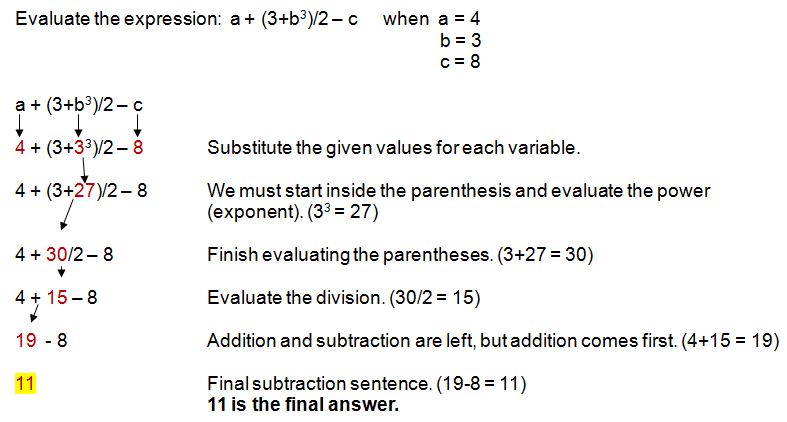
When we're asked to evaluate an expression with a variable, we're also usually given the value that variable represents. It’s like the secret decoder ring finally telling us what the symbol means!
Example 5: A Variable Joins the Party
Let's evaluate: x + 9, where x = 5.
Okay, so our mystery box 'x' has the value 5 inside. We just swap out the 'x' for the number 5. So the expression becomes 5 + 9.
And what is 5 + 9? You guessed it: 14!
So, when x is 5, the expression x + 9 evaluates to 14. Simple swap-a-roo!
Example 6: More Variable Fun
Let's try another one: 7y, where y = 3.
When you see a number right next to a variable, it means multiplication. So, 7y means 7 times y. Since y is 3, we have 7 * 3.
And 7 times 3 is 21!
See how the variable just acts as a placeholder? Once you know what it stands for, it's just a regular math problem again.
Example 7: Subtraction with a Twist
Evaluate: 12 - a, where a = 4.
We swap 'a' for 4, giving us 12 - 4.
And 12 - 4 equals 8.
You're getting the hang of this! It's all about substitution and then doing the math. No sweat, right?
Example 8: Division Drama
Let's do a division one with a variable: b / 2, where b = 10.
![[ANSWERED] Evaluate each of the following expressions a 80 000 1 0 04](https://media.kunduz.com/media/sug-question-candidate/20240115151719525460-6508023.jpg?h=512)
Substitute 'b' with 10, and we get 10 / 2.
And 10 divided by 2 is 5.
So, when b is 10, b/2 is 5. You're totally rocking this!
Order of Operations: The Unsung Hero (or Villain?)
Okay, now we're going to talk about something really important. Sometimes, an expression has more than one operation. For instance, you might see 3 + 2 * 4. What do you do first? Do you add 3 and 2, and then multiply by 4? Or do you multiply 2 and 4, and then add 3?
This is where the Order of Operations comes in. It's like the traffic laws of mathematics. Without them, things would be chaotic, and everyone would get a different answer. And nobody likes mathematical road rage!
We usually remember the order of operations with a handy acronym: PEMDAS or BODMAS.
- Parentheses (or Brackets)
- Exponents (or Orders)
- Multiplication and Division (from left to right)
- Addition and Subtraction (from left to right)
Think of it as a priority list. You tackle what's inside the parentheses first, then deal with any exponents, then do all multiplications and divisions as you encounter them from left to right, and finally, finish up with additions and subtractions, again, from left to right.
Example 9: PEMDAS in Action (Part 1)
Let's evaluate: 3 + 2 * 4.
According to PEMDAS, we do multiplication before addition. So, first, we calculate 2 * 4 = 8.
Now our expression is 3 + 8.
And 3 + 8 equals 11!
If we had done it the other way (adding first), we would have gotten (3 + 2) * 4 = 5 * 4 = 20. See? Different answers! PEMDAS keeps us all on the same page.
Example 10: PEMDAS in Action (Part 2)
Let's try another one: (5 + 2) * 3.
Here, we have parentheses! So, we must deal with what's inside them first. 5 + 2 = 7.
Now our expression becomes 7 * 3.
And 7 * 3 is 21.
The parentheses are like a VIP section – whatever's in there gets dealt with first!
Example 11: Division and Subtraction
Evaluate: 10 - 6 / 2.
PEMDAS tells us to do division before subtraction. So, first, 6 / 2 = 3.
Our expression is now 10 - 3.
And 10 - 3 equals 7.
It's all about respecting the order. No cutting in line!
Example 12: A Bit of Everything
Let's get a little fancy: 4 * (6 - 2) + 5.
First, parentheses: 6 - 2 = 4.
The expression is now: 4 * 4 + 5.
Next, multiplication: 4 * 4 = 16.
Now we have: 16 + 5.
Finally, addition: 16 + 5 = 21.
Ta-da! You've navigated a multi-step expression like a pro. Give yourself a pat on the back!
Expressions with Exponents
Exponents are those little numbers written as superscripts. They tell you to multiply a number by itself a certain number of times. For example, 2³ means 2 * 2 * 2.
Example 13: The Power of Exponents
Evaluate: 3² + 5.
According to PEMDAS, exponents come before addition. So, 3² = 3 * 3 = 9.
Our expression becomes 9 + 5.
And 9 + 5 is 14.
Example 14: Exponents and Parentheses
Let's try: (2 + 3)³.
Parentheses first: 2 + 3 = 5.
Now we have 5³.
This means 5 * 5 * 5. So, 5 * 5 = 25, and 25 * 5 = 125.
Wowza! Exponents can make numbers grow fast!
Putting It All Together: The Grand Finale
So, to recap, evaluating an expression means finding its single numerical value. We do this by:
- Substituting any variables with their given values.
- Following the Order of Operations (PEMDAS/BODMAS) religiously.
- Performing the indicated calculations step-by-step.
It might seem like a lot at first, but with practice, it becomes second nature. Think of it like learning to ride a bike. At first, you wobble a bit, maybe even fall off (metaphorically speaking, of course!). But soon, you're cruising along, no hands!
Every time you evaluate an expression, you're exercising your brain, sharpening your problem-solving skills, and gaining a deeper understanding of how numbers work together. You're not just crunching numbers; you're unlocking the secrets of mathematical language.
And guess what? You've done a fantastic job today! You've tackled simple arithmetic, played with variables, and even conquered the mighty Order of Operations. That's some serious brainpower at work!
Remember, math isn't about being perfect from the start; it's about the journey of learning and the joy of discovery. So, keep practicing, keep exploring, and most importantly, keep that smile on your face. You've got this!

![[ANSWERED] Evaluate the following expressions Your answers must be - Kunduz](https://media.kunduz.com/media/sug-question-candidate/20230417054911697595-3882370.jpg?h=512)
![[ANSWERED] Evaluate the following expressions 4 1 3 3 a b 2 2 8 14 8 14](https://media.kunduz.com/media/sug-question-candidate/20230912170447824306-4754400.jpg?h=512)
![[Solved] | SolutionInn](https://dsd5zvtm8ll6.cloudfront.net/questions/2023/12/657add9d533f1_1702640909796.jpg)