Ever find yourself gazing through a telescope, marveling at distant galaxies, or perhaps squinting at tiny text on a prescription lens? There's a certain magic in how lenses bend light, transforming our perception of the world. And for those who dabble in photography, or even just enjoy the satisfying click of a camera, understanding how multiple lenses work together is a fascinating, and surprisingly useful, endeavor. Think of it like building with LEGOs, but with light – you can combine simple pieces to create something entirely new and spectacular!
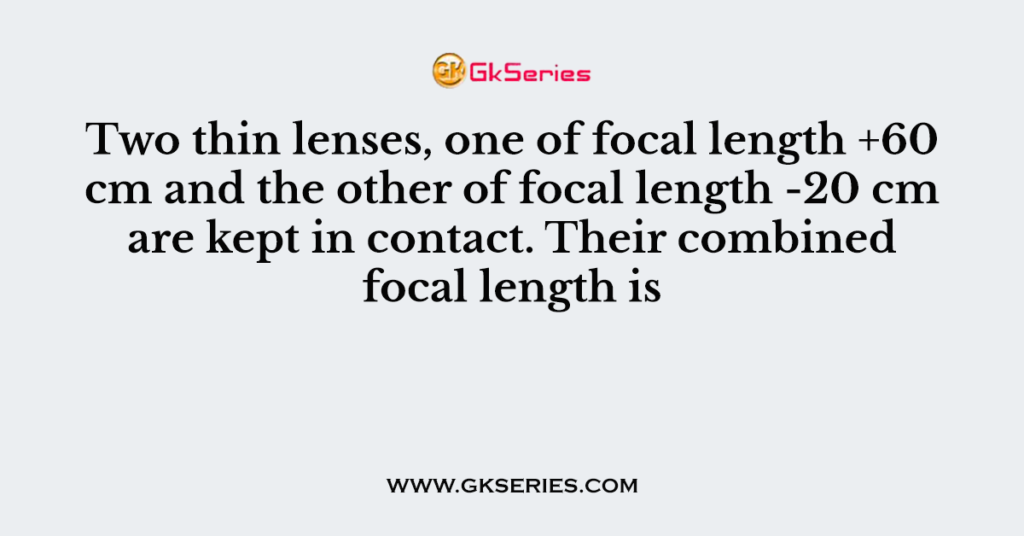
This brings us to the rather intriguing topic of the equivalent focal length of two thin lenses. Now, before your eyes glaze over with images of complicated physics equations, let's break it down in a way that's both fun and functional. At its core, this concept explains how, when you stack two lenses one after another, they behave as if they were a single lens with a specific focal length. This isn't just an abstract theoretical concept; it has very real, practical applications that enhance our everyday lives in subtle yet significant ways.
So, what's the big deal? Why should you care about the combined effect of two lenses? Well, imagine you're a photographer. You might have a wide-angle lens for capturing expansive landscapes and a telephoto lens for zooming in on distant subjects. When you combine elements from different lens systems, or even when a professional camera lens itself is made up of multiple internal elements, understanding the equivalent focal length helps predict the overall magnification and field of view. It's the secret sauce behind achieving that specific look or perspective you're going for. Think of a zoom lens; it's essentially a clever arrangement of multiple lens elements that effectively changes its focal length, allowing you to go from wide to telephoto with a twist!
Beyond photography, this principle is fundamental to the design of optical instruments. The sophisticated eyepieces of microscopes and telescopes, which allow us to see the impossibly small and the incredibly far, rely on this very idea. Even the corrective lenses in your eyeglasses are carefully chosen and positioned to achieve a desired optical outcome. For instance, combining lenses can help correct complex vision issues more effectively than a single lens alone. It’s about optimizing how light enters your eye to give you the clearest, most comfortable vision.

Ready to dive a little deeper and make this knowledge work for you? If you're a budding photographer, experimenting with close-up filters or teleconverters can be a great way to explore this concept. These accessories are essentially extra lenses that you attach to your existing lens, and understanding their impact on the focal length will dramatically improve your results. For those curious about optics, a simple experiment can be enlightening. Take two magnifying glasses of different strengths and hold them together. Observe how the combined magnification changes. You'll be experiencing the principle of equivalent focal length firsthand!
The key to truly enjoying this is to approach it with a spirit of curiosity and experimentation. Don't be afraid to play around. If you're working with optics, measure and observe. Take notes on what happens when you combine different lenses. The more you engage with the concept, the more intuitive it becomes, and the more you'll appreciate the elegant science behind the images you capture and the world you see.


![[ANSWERED] Two similar thin equi convex lenses of focal length feach](https://media.kunduz.com/media/sug-question-candidate/20200728163810283116-1894102.jpg?h=512)