So, you're at a fancy café, right? You’ve just ordered a ridiculously oversized latte that costs more than your last Netflix binge, and your friend starts talking about… hyperbolas. You probably picture something going terribly wrong with a math problem, like a rogue calculator staging a rebellion. But fear not, fellow caffeine enthusiasts and reluctant math wranglers! Today, we're diving into the wild, wacky world of hyperbolas, specifically how to nab their equation when you've got their vertices and foci. Think of it like being a detective, but instead of a smoky back alley, your crime scene is a pristine graph paper, and your clues are these fancy points.
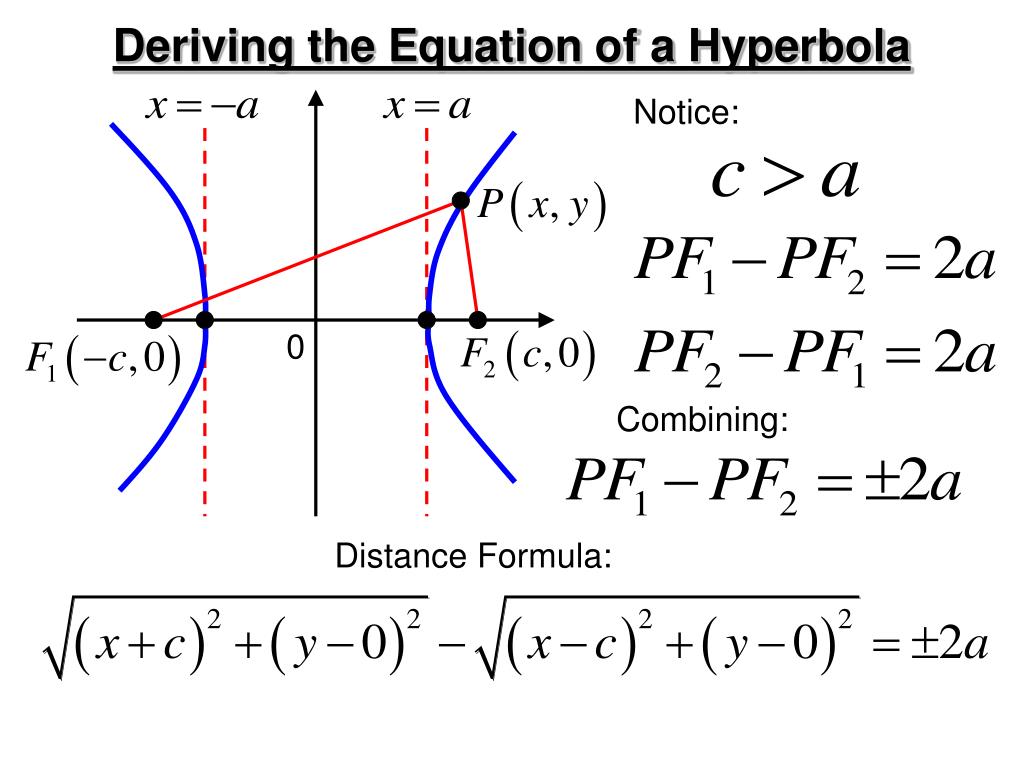
Now, what's a hyperbola, anyway? Is it like a super-duper parabola? Not quite. Imagine two parabolas, but they’re pointing away from each other, like they just had a massive argument about who gets the last croissant. They never, ever touch. It’s a bit dramatic, really. They’re defined by a super cool property: for any point on a hyperbola, the difference of its distances to two fixed points (those are our foci, the stars of our show!) is always a constant. It's like a mathematical obsession. "Oh, you're that far from point A and this far from point B? The difference is always… this number! Fascinating!"
Let's get down to business. You’re given the vertices. These are the "tips" of your hyperbola, the closest points to the center. And you've got the foci. These are those two fixed points we were just gossiping about. These two sets of points are your golden tickets to unlocking the hyperbola's secret equation. It’s like having the ingredients and the recipe for a super-secret mathematical cookie.
The Key Players in Our Hyperbola Heist
Before we get our hands dirty with numbers, let's understand our main characters. We’ve got:
- The Vertices (V): These are the points where the hyperbola actually, you know, exists. They’re like the anchors of our dramatic curves.
- The Foci (F): These are the magical, invisible magnets that dictate the hyperbola’s shape. They’re always further out than the vertices. Think of them as the gossip mongers, always pulling the curves towards them, but never quite reaching them.
- The Center (C): This is the midpoint between the two vertices, and also the midpoint between the two foci. It’s the neutral territory where the two opposing parabolas are born.
- 'a' and 'c': These aren't just random letters thrown in by a bored math teacher. 'a' is the distance from the center to a vertex. 'c' is the distance from the center to a focus. These two are super important.
Here's a funny little truth: 'c' will always be bigger than 'a'. Why? Because the foci are always outside the vertices. It's like your boss always wanting more from you than you can realistically give. "Just one more report!" "Just one more vertex!"
The Cosmic Dance of 'a' and 'c'
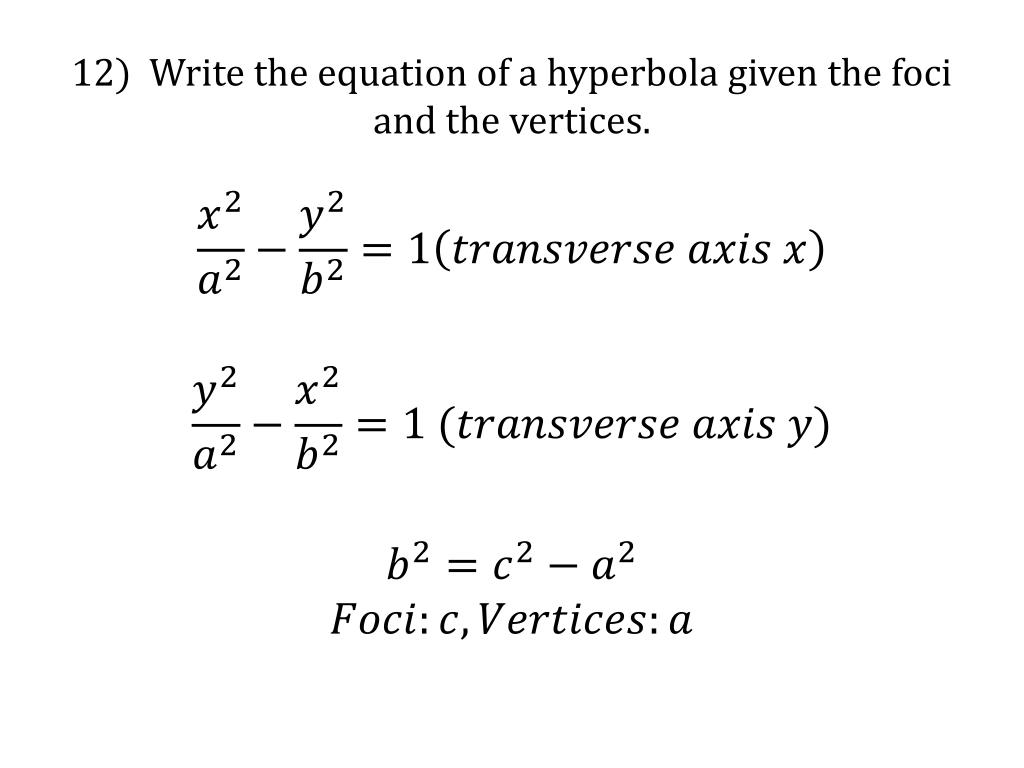
Now, for the real magic. We need a third important number, let's call it 'b'. This 'b' is related to 'a' and 'c' by a neat little Pythagorean-esque relationship: c² = a² + b². So, if you know 'a' and 'c', you can find 'b'! It's like a mathematical love triangle, but with squares and addition. If 'c' is your overbearing parent and 'a' is your rebellious teen, 'b' is the therapist trying to mediate the chaos.

The orientation of your hyperbola is also crucial. Is it opening left and right, or up and down? This is determined by whether the transverse axis (the line connecting the vertices) is horizontal or vertical. Don't worry, it’s not as complicated as deciphering IKEA instructions.
Scenario 1: The Horizontal Hustle
Let's say your vertices are at (h-a, k) and (h+a, k), and your foci are at (h-c, k) and (h+c, k). Notice how the 'k' value stays the same? That means your hyperbola is chilling horizontally, like a cat loafing on a sunny windowsill. The center, my friends, is at (h, k). Your equation will look something like this:
(x - h)² / a² - (y - k)² / b² = 1
See that '1' on the right side? That’s your signal! And the 'x' term comes first, making it the big cheese, the dominant variable. It’s like the popular kid at school, always getting the attention. The 'y' term is a bit more subdued, paying tribute to the mighty 'x'.
Scenario 2: The Vertical Voyage
Now, what if your vertices are at (h, k-a) and (h, k+a), and your foci are at (h, k-c) and (h, k+c)? The 'h' value is constant here. This hyperbola is standing tall, like a giraffe trying to reach the tastiest leaves. The center is still at (h, k). But our equation does a little flip-flop:
(y - k)² / a² - (x - h)² / b² = 1
Aha! The 'y' term is now in the starring role, kicking the 'x' term to the curb. It's like the underdog finally getting their moment in the spotlight. The '1' is still there, the unchanging beacon of hyperbola-ness.
Putting It All Together: A Case Study (Without the Actual Math Problems, Because My Brain Hurts)
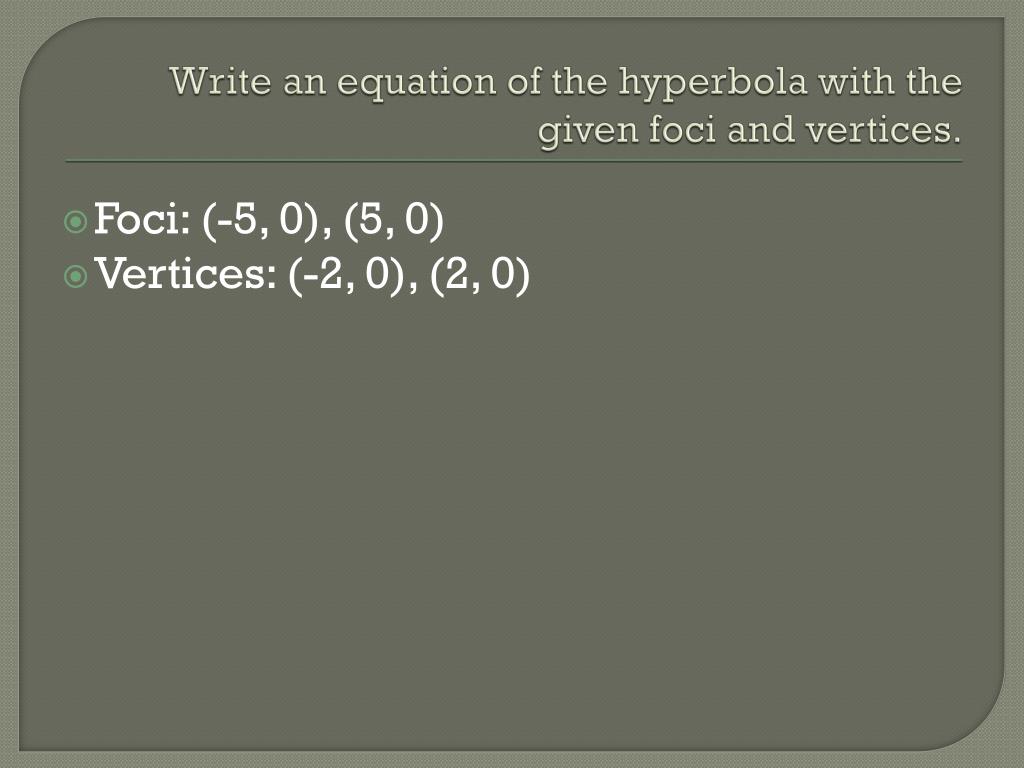
Imagine your vertices are at (-3, 2) and (5, 2). Your foci are at (-4, 2) and (6, 2). First, let's find our center. It's the midpoint of (-3, 2) and (5, 2), which is ((-3+5)/2, (2+2)/2) = (1, 2). Bingo! Our center (h, k) is (1, 2).

Now, let's find 'a'. It's the distance from the center (1, 2) to a vertex, say (5, 2). That's 5 - 1 = 4. So, a = 4.
Next, 'c'. It's the distance from the center (1, 2) to a focus, say (6, 2). That's 6 - 1 = 5. So, c = 5.
Since the 'y' coordinate of the vertices and foci is the same (it's always 2!), our hyperbola is opening horizontally. We're in Scenario 1 territory!
Now, we need 'b'. Remember our secret formula: c² = a² + b². So, 5² = 4² + b². That's 25 = 16 + b². Subtract 16 from both sides, and we get b² = 9. So, b = 3.

Now, plug and chug into our horizontal equation: (x - h)² / a² - (y - k)² / b² = 1. We have h=1, k=2, a=4, and b=3.
This gives us: (x - 1)² / 4² - (y - 2)² / 3² = 1
Or, to be a bit neater: (x - 1)² / 16 - (y - 2)² / 9 = 1
Ta-da! You've just conquered a hyperbola equation! You’ve wrestled it into submission and made it reveal its innermost secrets. You're practically a mathematical superhero. Now, if you'll excuse me, I think my ridiculously oversized latte is calling my name. And perhaps a very large slice of cake. We’ve earned it.

+--+Vertical.jpg)