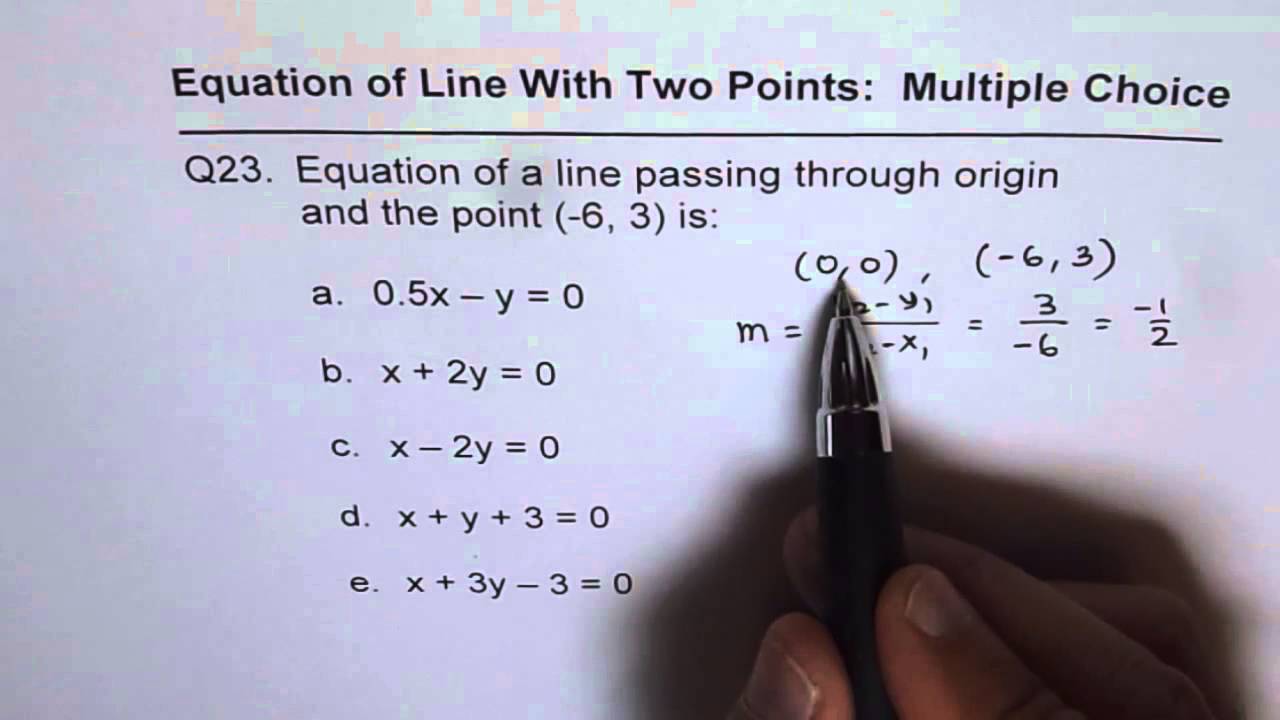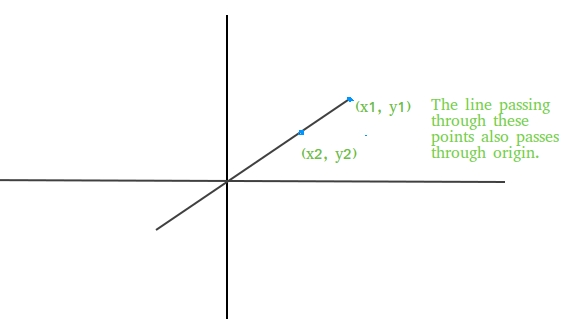
Hey there, math adventurer! Today, we're going to tackle a super cool concept: the equation of a line that's doing something pretty special. We're talking about lines that just love the origin. You know, that cozy little spot where the x and y axes meet? The place that’s basically the VIP lounge of the graph world. So, grab a comfy seat, maybe a snack (math is always better with snacks, right?), and let's dive into the wonderful world of lines passing through the origin!
So, what exactly is an equation of a line? Think of it as a secret code that describes every single point on that line. It’s like a recipe that tells you exactly how to find any point on it, as long as you know a couple of key ingredients. Normally, a line's equation has a bit of everything in it, but when a line decides to make its grand entrance right through the origin, things get a whole lot simpler. It’s like a minimalist artist – no frills, just the essentials!
Remember the general form of a linear equation? It often looks something like y = mx + b. Now, this is like the all-star lineup of line equations. Here, 'y' and 'x' are your coordinates – they represent the position of any point on the line. 'm' is the slope, which tells you how steep the line is and in which direction it's going (up and to the right, or down and to the left, or somewhere in between). And then there's 'b', the y-intercept. This is the point where the line crosses the y-axis. It’s where the line starts its journey up or down the y-axis.
But here’s the magic trick for lines passing through the origin! When a line decides to party at the origin, guess what happens to that 'b' value? Yep, it becomes zero! Think about it: the origin is the point (0, 0). For a line to pass through the origin, it must cross the y-axis at y = 0. So, the y-intercept, our 'b', is inherently 0. Poof! It just disappears from the equation.
So, our fancy general equation, y = mx + b, suddenly simplifies into something much, much sleeker. It becomes: y = mx.
Isn't that neat? It's like the line got dressed up for a formal event and decided to ditch the extra accessories. All it needs is its slope ('m') and it knows exactly where to go. It’s the ultimate efficient traveler of the graph!
Let’s break down what y = mx really means. We already know 'y' and 'x' are your coordinates. The star of the show here is still 'm', the slope. The slope tells you the relationship between the change in y and the change in x. For every unit you move in the x-direction, you move 'm' units in the y-direction. It’s like a perfectly balanced scale.
If 'm' is positive, the line will slant upwards as you move from left to right. Imagine you're walking uphill – that's a positive slope! If 'm' is negative, the line slants downwards. That’s like walking downhill. And if 'm' is zero? Well, then the line is perfectly flat, perfectly horizontal, just like a serene lake. (Though, a horizontal line through the origin would just be the x-axis itself, which is kind of a special case of a horizontal line, but still counts!).
What about a vertical line? Vertical lines have an undefined slope. They're like a sheer cliff face – you can't really walk up them in a smooth, consistent way. A vertical line passing through the origin would be the y-axis itself, and its equation is simply x = 0. So, even this special case fits within the broader idea, though it's expressed slightly differently.
Let's play a game. Imagine you have a point (2, 4) and you know that the line passing through it also passes through the origin. Can we find the equation of this line? You bet we can!

We know the equation form is y = mx. We have a point (x, y) = (2, 4) that lies on this line. So, we can plug these values into our equation:
4 = m * 2
Now, we just need to solve for 'm'. To get 'm' by itself, we divide both sides by 2:
4 / 2 = m
2 = m
So, the slope 'm' is 2. And what's our equation? Drumroll, please… y = 2x!
See? It's like a little detective story, and we just found the crucial clue!
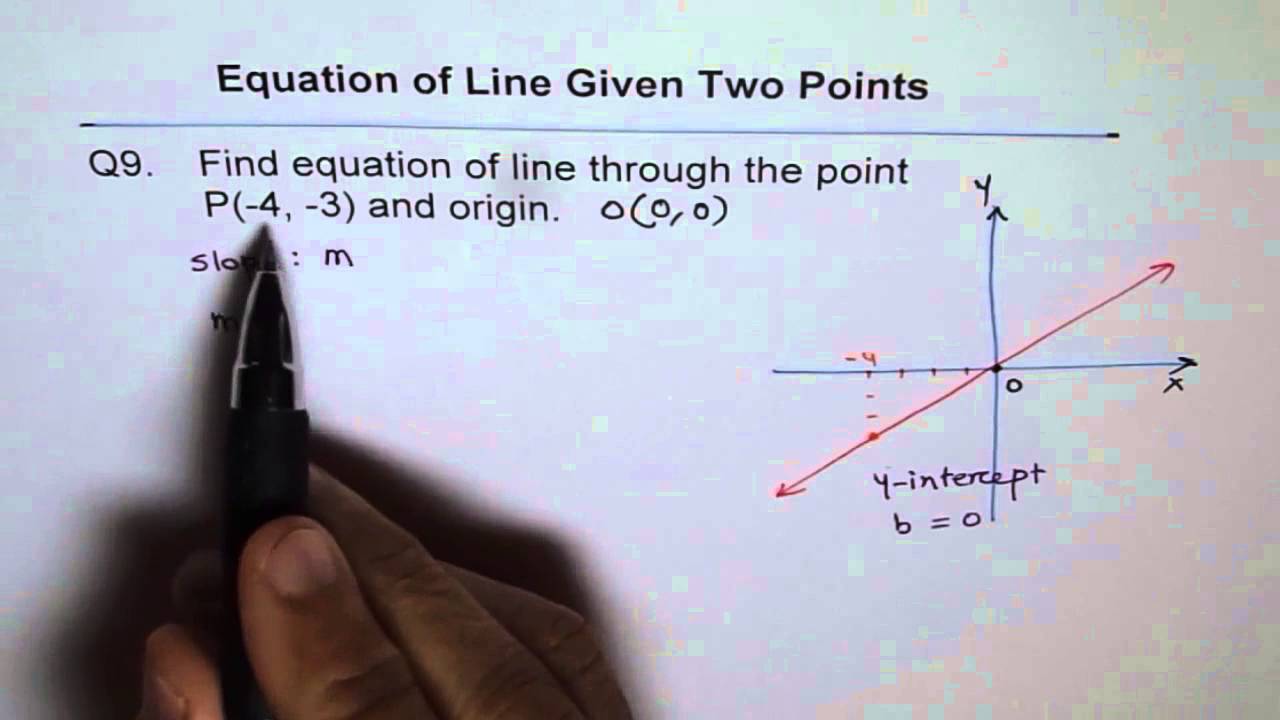
Let's try another one. Suppose a line passes through the origin and the point (-3, 6). What’s its equation?
Again, we start with y = mx. Our point is (x, y) = (-3, 6).
Plugging them in:
6 = m * (-3)
To find 'm', we divide both sides by -3:
6 / -3 = m
-2 = m
Our slope 'm' is -2. So, the equation of the line is y = -2x.
This means for every step we take to the right (increase in x), the line goes down 2 steps (decrease in y). It's like a perfectly choreographed dance.
The beauty of lines passing through the origin is their direct proportionality. If you double the x-value, you also double the y-value. If you halve the x-value, you halve the y-value. They’re perfectly balanced and predictable in this way. It's like a cause-and-effect relationship where the cause is directly proportional to the effect.
Think about real-world examples. If you're buying apples at a fixed price per apple, the total cost (y) is directly proportional to the number of apples you buy (x). If each apple costs $1.50, then the equation is Cost = 1.50 * NumberOfApples, or y = 1.5x. This line passes through the origin because if you buy zero apples, you pay zero dollars. No surprises there!
Another example: If you’re driving at a constant speed, the distance you travel (y) is directly proportional to the time you drive (x). If you’re driving at 60 miles per hour, your equation is Distance = 60 * Time, or y = 60x. At zero time, you've traveled zero distance. Makes perfect sense!
So, whenever you see a relationship where one quantity is directly proportional to another, and you know that when one is zero, the other is also zero, chances are you're looking at a line that passes through the origin. Its equation will be in the simple form y = mx.
It's important to remember that the origin (0, 0) is always a point on these lines. You can plug x=0 into y = mx, and you’ll always get y = m * 0 = 0. So, the point (0, 0) is automatically satisfied!
Let’s recap the key takeaways, because this stuff is gold:

1. The Simple Form: Lines passing through the origin have the equation y = mx. No "+ b" to worry about!
2. The Slope is King: The 'm' in y = mx is your slope. It dictates the steepness and direction of the line.
3. Direct Proportionality: These lines represent relationships where one variable is directly proportional to another.
4. Origin is Guaranteed: The point (0, 0) is always on the line.
5. Finding the Slope: If you have a point (x, y) on the line (besides the origin), you can find 'm' by calculating m = y / x.
So, next time you see a line that seems to be aiming straight for that central crossroads, you’ll know exactly how to describe it. It’s not some complicated beast; it’s a beautifully simple relationship, a direct connection between two variables, starting from the very heart of the graph.
Learning about lines passing through the origin isn't just about memorizing a formula; it's about understanding a fundamental concept in math and in the world around us. It's about recognizing patterns, appreciating simplicity, and seeing how elegance can arise from straightforward rules. You’ve just unlocked another piece of the amazing puzzle that is mathematics!
Keep exploring, keep questioning, and keep that amazing curiosity alive. You've got this, and the world of math is always ready to surprise you with its beautiful, interconnected wonders. So go forth and graph with confidence – the origin is just the beginning of your many mathematical adventures!