Hey there, science explorers! Ever feel like chemistry is this big, scary monster lurking in the shadows of your brain? Well, get ready to poke it with a friendly stick, because today we’re diving into something that sounds a little intimidating but is actually quite delightful: the wonderful world of acids! More specifically, we're going to untangle the difference between two cool types: binary acids and oxyacids. Don't worry, it's going to be more like a friendly picnic than a grueling exam.
So, what exactly are we talking about here? Acids, in general, are those fascinating compounds that tend to donate protons (little positively charged guys) when they dissolve in water. Think of them as the life of the party, always eager to share their enthusiasm! But just like parties can have different vibes – a chill acoustic set versus a high-energy dance party – acids have their own distinct flavors and structures.
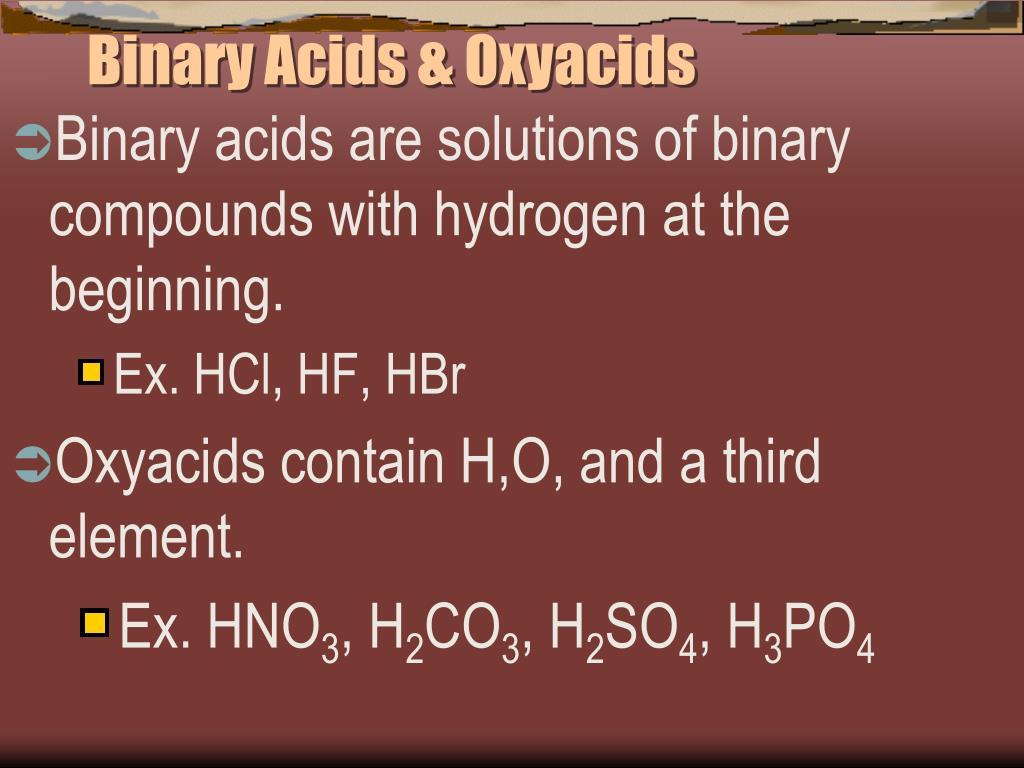
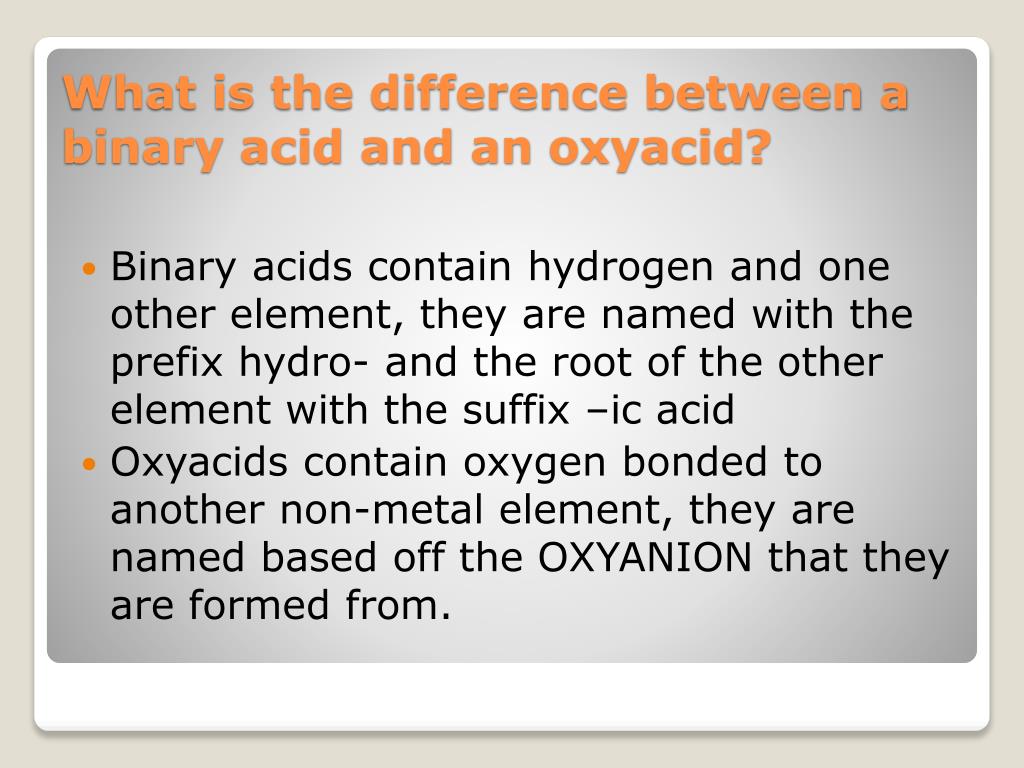
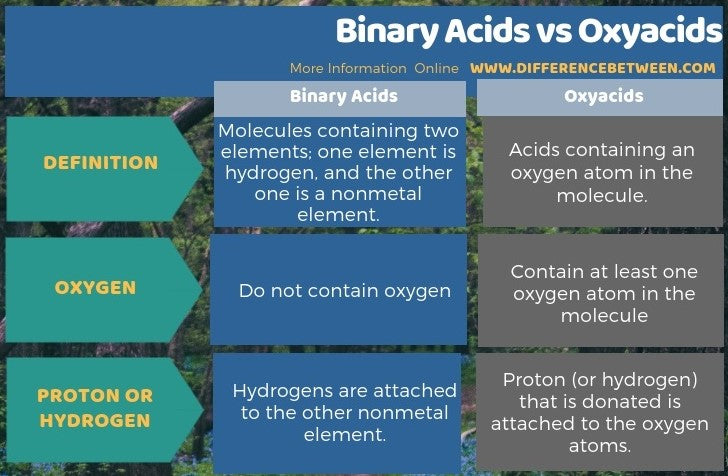
Let’s kick things off with our first contender: the binary acids. The name itself gives us a big clue, doesn't it? "Binary" means made of two! And in the case of these acids, those two things are hydrogen and one other nonmetal element. That’s it! Simple as that. They’re like the elegant, minimalist duo of the acid world. Think of them as the perfectly brewed black coffee – straightforward, gets the job done, and a classic for a reason.
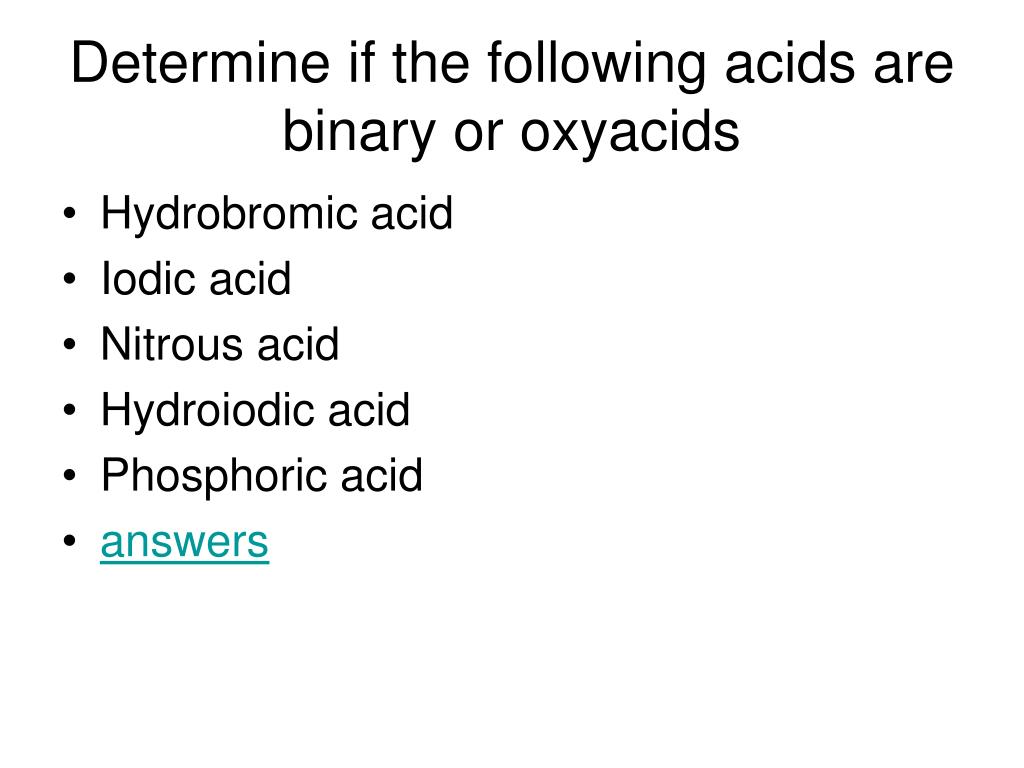
The magic ingredient in binary acids, besides hydrogen, is usually a halogen. You know, those guys from Group 17 on the periodic table: fluorine, chlorine, bromine, and iodine. So, when hydrogen teams up with one of these, and they get dissolved in water, BAM! You've got yourself a binary acid. The naming convention is also super straightforward. You take the name of the nonmetal, add an "-ic" to the end, and then slap "hydro-" on the front. Easy peasy, right?
For example, if you have hydrogen and chlorine hanging out together, you get hydrochloric acid (HCl). That's the stuff your stomach uses to digest your lunch! Pretty cool, huh? Or how about hydrogen and fluorine? That makes hydrofluoric acid (HF). Now, HF is a bit of a wild child and requires some serious respect – it can be quite dangerous. But even its name follows the same simple pattern. And let's not forget hydrobromic acid (HBr) and hydroiodic acid (HI). They’re all part of the same friendly binary acid family.

These binary acids are foundational. They’re the building blocks, the straightforward characters in our chemical story. Knowing them is like knowing your basic greetings in a new language – essential and opens up a whole world of communication. Plus, understanding these simple structures helps us appreciate the more complex ones that are coming up.
Now, let's switch gears and talk about our second group: the oxyacids. If binary acids are the minimalist duo, oxyacids are the vibrant, multi-talented ensemble. The key differentiator here is that these acids contain hydrogen, oxygen, and at least one other nonmetal element. See the extra ingredient? That's the oxygen! It's like adding a whole orchestra to our simple duo.
These guys are where things get a little more visually interesting. Instead of just a hydrogen bonded to a single nonmetal, you often have a central nonmetal atom surrounded by oxygen atoms, and then hydrogen atoms attached to those oxygens. It’s a bit like a molecular flower with hydrogen petals! This oxygen-rich structure gives them different properties and allows for a wider range of chemical reactions.

The naming of oxyacids can seem a tad more involved at first glance, but once you get the hang of it, it's like unlocking a secret code! It’s all about the anion (the negatively charged part) that the hydrogen is attached to. Remember those polyatomic ions you might have heard whispers about? Like sulfate or nitrate? Well, they're the backbone of many oxyacids!
Here’s the general rule, and it’s a fun one: if the polyatomic ion ends in "-ate," the corresponding oxyacid ends in "-ic." If the polyatomic ion ends in "-ite," the oxyacid ends in "-ous." It’s like a little linguistic dance! So, if you have the sulfate ion (SO₄²⁻), its acid buddy is sulfuric acid (H₂SO₄). If you have the sulfite ion (SO₃²⁻), its acid friend is sulfurous acid (H₂SO₃). Notice how the central element (sulfur) and the oxygen are still there, but the number of oxygen atoms can change, leading to different acids.

Let's try another! The nitrate ion (NO₃⁻) gives us nitric acid (HNO₃). And the nitrite ion (NO₂⁻) brings us nitrous acid (HNO₂). It's like a family reunion where everyone has a distinct but related name. These oxyacids are incredibly important and show up in so many places. Think of the powerful role nitric acid plays in fertilizer production, or how sulfuric acid is a workhorse in the chemical industry. They’re the unsung heroes of countless everyday products!
What makes this distinction fun, you ask? Well, it’s about understanding the why behind the what. It's like appreciating the difference between a perfectly ripe apple and a beautifully crafted apple pie. Both are delicious, but they involve different processes and ingredients. Knowing the difference between binary and oxyacids helps you predict their behavior, understand their reactions, and even appreciate the cleverness of chemists who discovered and named them.
It's also about building your confidence! Every time you grasp a new concept in chemistry, you're expanding your intellectual toolkit. You're becoming more equipped to understand the world around you, from the food you eat to the materials you use. These aren't just dry facts; they are the keys to unlocking a deeper understanding of how everything works.
So, the next time you see HCl or H₂SO₄, you'll know instantly if it's a simple two-element acid or a more complex, oxygen-rich one. You'll understand the subtle differences in their structures and how that might influence their properties. This isn't just memorization; it's building a mental map of the chemical landscape.
And honestly, isn't there a thrill in cracking a code? In understanding the logic behind scientific nomenclature? It’s like being a detective, piecing together clues from the name to understand the nature of the substance. This knowledge empowers you, making chemistry less of a mystery and more of an exciting adventure.
So go forth, my curious friends! Embrace these differences. They are not barriers, but rather pathways to a richer understanding. Each new concept you learn is a step towards a more informed and wonder-filled view of the universe. Keep exploring, keep questioning, and remember, the journey of learning is its own beautiful reward. You've got this!