Hey there, science enthusiasts and curious minds! Ever looked at a package of plant food and wondered about the magic that makes your tomatoes so juicy or your sunflowers so tall? Well, today we're diving into a little piece of that magic: calculating the formula mass of calcium nitrate! Don't let the fancy name scare you; it's actually a super fun puzzle that can add a sprinkle of scientific wonder to your day. And who knows, it might just make you see the world in a whole new, delightfully chemical way!
So, what exactly is formula mass? Think of it like building with LEGOs. Each atom is a different colored brick, and when you put them together to make a compound – like calcium nitrate – you want to know the total weight of all those bricks combined. That, my friends, is formula mass! It's a fundamental concept in chemistry, but we’re going to tackle it with a smile and absolutely no stuffy textbooks. Promise!
Let's Get Our Hands Dirty (Figuratively, Of Course!)
Our star player today is calcium nitrate. Sounds like something a gardener would whisper sweet nothings to, right? And you wouldn't be far off! Calcium nitrate is a fantastic fertilizer, giving plants the calcium and nitrogen they crave to grow big and strong. It’s like a multivitamin for your garden!
First things first, we need its chemical formula. And guess what? This is where the fun really begins! For calcium nitrate, the formula is Ca(NO₃)₂. See that? It’s like a secret code! Let's break it down:
- Ca: That's our buddy, Calcium. He's a metal, and in this compound, he's playing nicely with others.
- (NO₃)₂: This little bit is a bit more complex, but we’ll tame it. Inside the parentheses, we have NO₃. This is the nitrate ion. It's a package deal, always sticking together. And the little ‘2’ outside the parentheses? That tells us we have two of these nitrate ions for every one calcium atom. Think of it like getting two scoops of ice cream for every one cone!
Isn't that neat? Chemistry isn't just about reactions; it's about understanding how these tiny building blocks arrange themselves. And once you know the formula, the rest is a piece of cake... or, rather, a piece of molecular pie!
The Atomic Weight Treasure Hunt
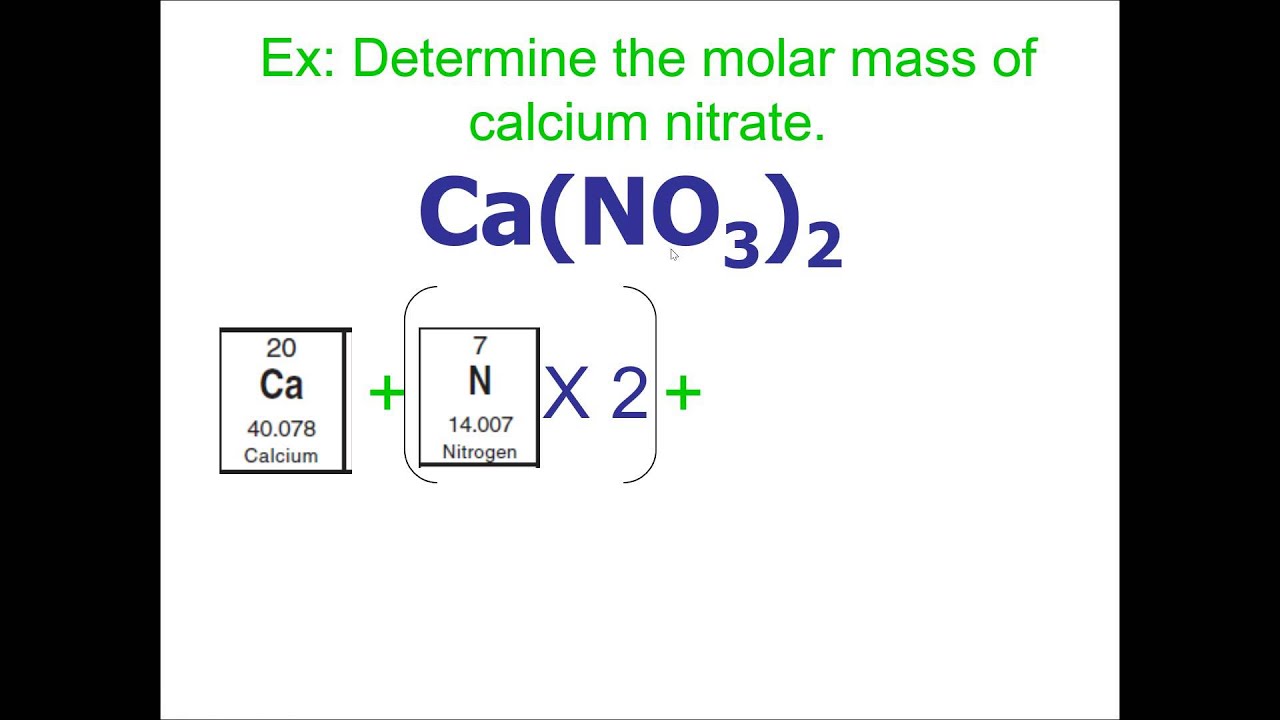
To calculate the formula mass, we need the atomic masses of each element involved. These are like the individual weights of our LEGO bricks. Where do we find these weights? Easy peasy! We use the periodic table. It’s like a superhero registry for elements, complete with their essential stats.
Let's grab our trusty periodic table (or just imagine one with me!). We need the atomic masses for:
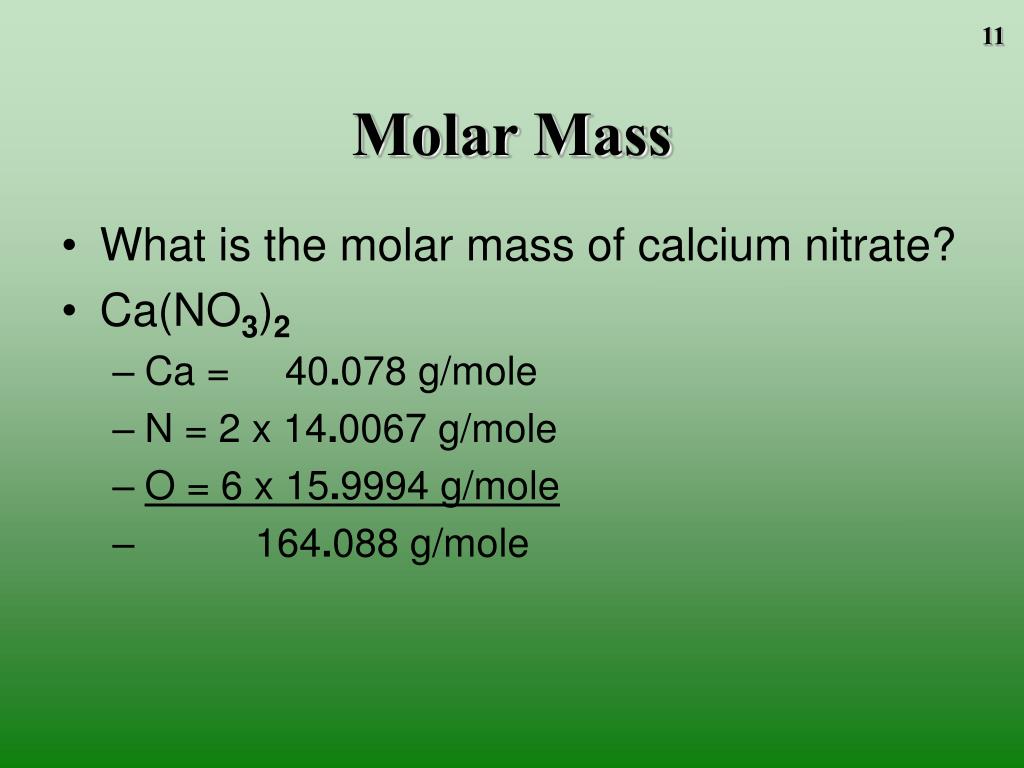
- Calcium (Ca): If you look him up, you’ll find his atomic mass is approximately 40.08 atomic mass units (amu). Let's round it to 40.1 amu for simplicity and a touch of playful approximation!
- Nitrogen (N): Our friend Nitrogen weighs in at about 14.01 amu. We'll use 14.0 amu.
- Oxygen (O): And Oxygen, the breath of life, is roughly 16.00 amu. We’ll stick with 16.0 amu.
See? No need to get bogged down in decimal places unless you're aiming for ultra-precision. For our purposes, these rounded numbers will do a fantastic job of showing us the overall "weight" of our calcium nitrate.
Putting the Pieces Together (The Fun Calculation Part!)
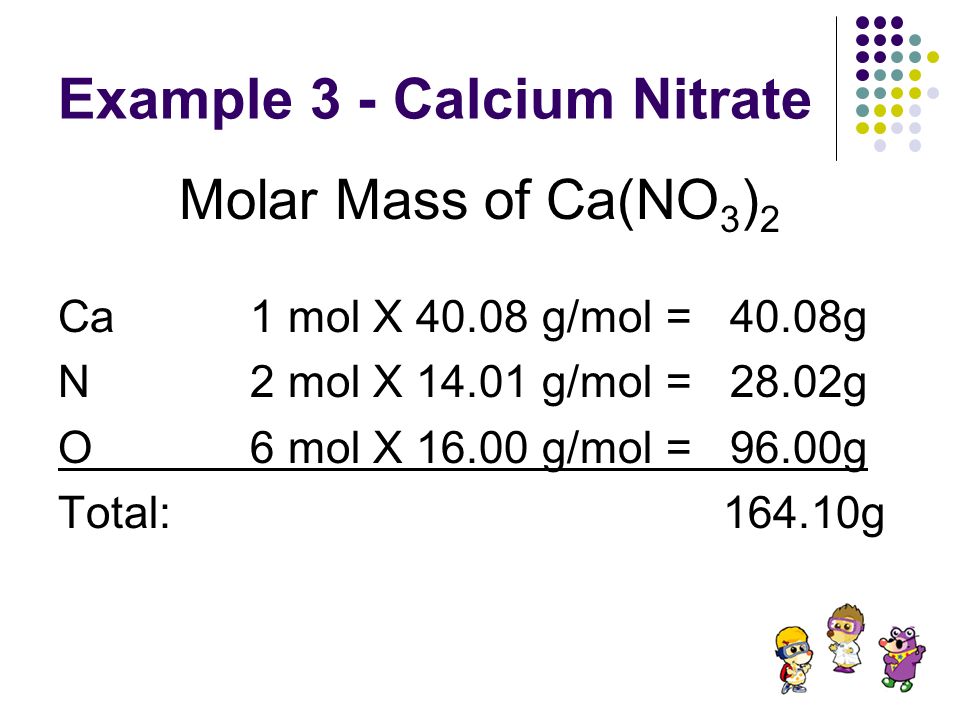
Now, for the grand finale! We’re going to combine our atomic masses according to the formula Ca(NO₃)₂. Remember, that little ‘2’ after the nitrate means we have twice the nitrogen and twice the oxygen within the nitrate ions. It’s like multiplying!
Let's break down the calculation step-by-step:
Step 1: Calcium's Contribution
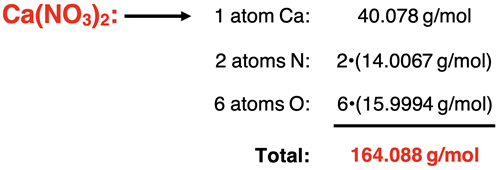
We have one calcium atom. So, its contribution to the total formula mass is simply its atomic mass:
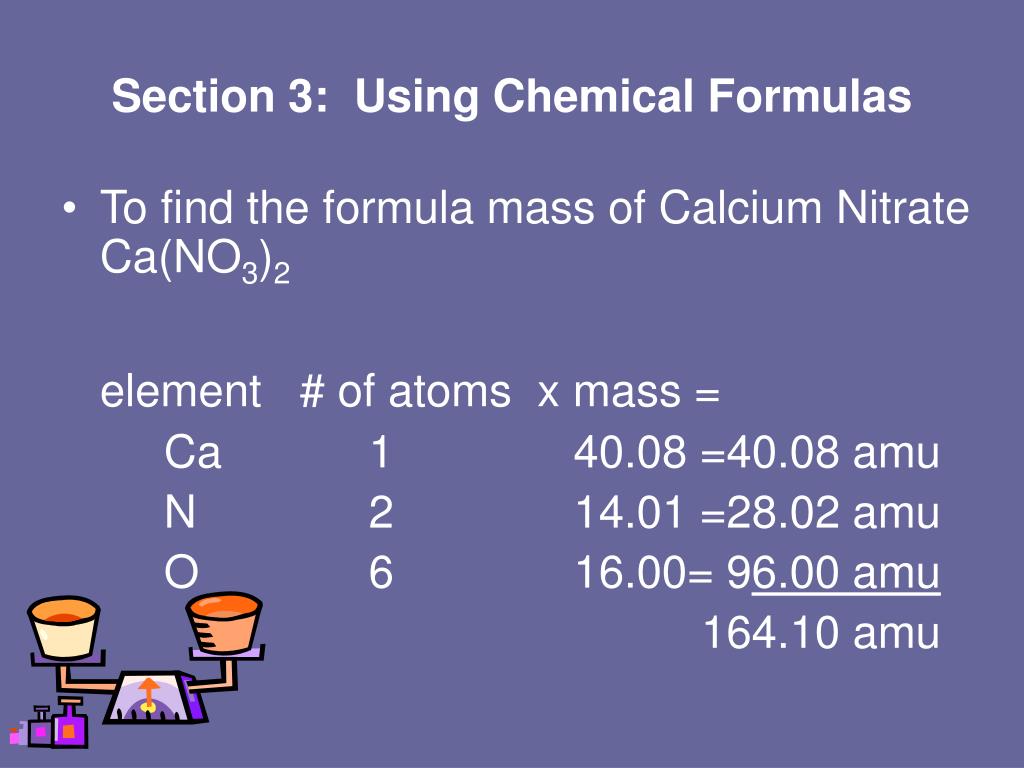
1 × 40.1 amu = 40.1 amu

Step 2: Nitrogen's Contribution
Now, look at the nitrate ion (NO₃). Inside it, there’s one nitrogen atom. But remember that ‘2’ outside the parentheses? We have two nitrate ions. So, we actually have 2 nitrogen atoms in total.
2 × 14.0 amu = 28.0 amu
Step 3: Oxygen's Contribution
Similarly, within one nitrate ion (NO₃), there are three oxygen atoms. Since we have two nitrate ions, we have 3 oxygen atoms per ion × 2 ions = 6 oxygen atoms in total.
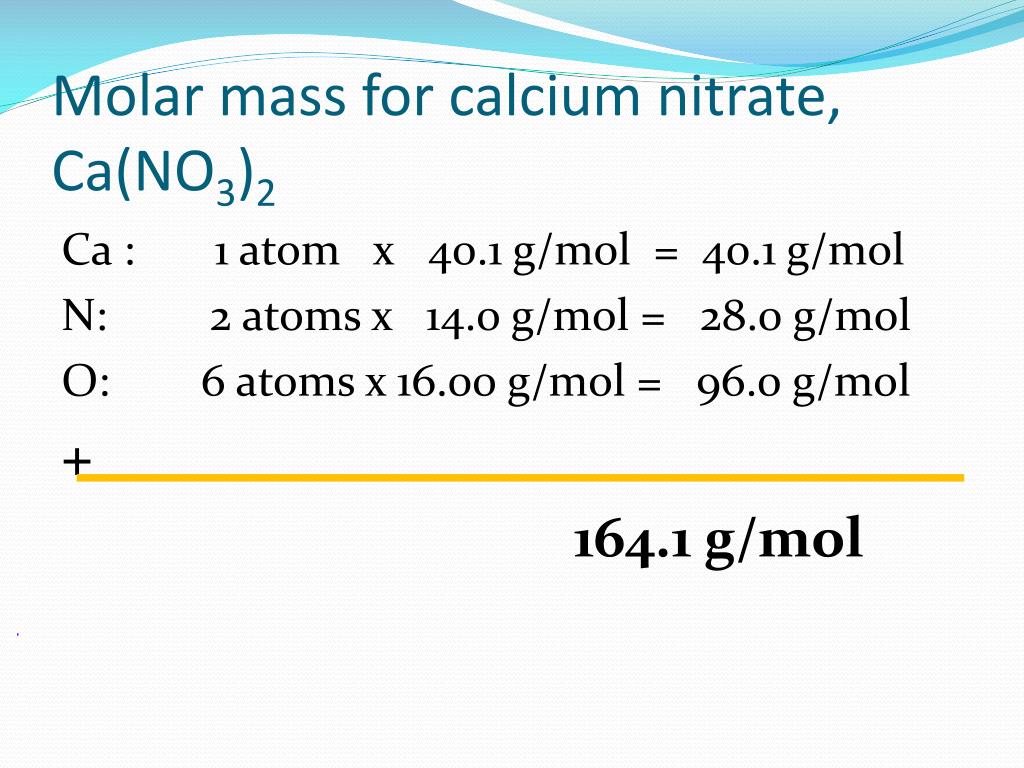
6 × 16.0 amu = 96.0 amu
Step 4: The Grand Total!
Now, we just add up the contributions from calcium, nitrogen, and oxygen:
40.1 amu (Calcium) + 28.0 amu (Nitrogen) + 96.0 amu (Oxygen) = 164.1 amu
Ta-da! The formula mass of calcium nitrate is approximately 164.1 amu. Isn't that incredibly satisfying? You’ve just taken a chemical formula and given it a concrete weight. It’s like weighing your favorite recipe ingredients before you start baking, but way cooler because it's the recipe for something plants adore!
Why Does This Even Matter (Besides Being Fun)?
You might be thinking, "Okay, that was neat, but what’s the big deal?" Well, knowing the formula mass is like having a secret key to the world of chemistry! It helps chemists, gardeners, and even food scientists understand how much of a substance they're dealing with. It's crucial for making sure fertilizers have the right balance of nutrients, for formulating medicines, and for all sorts of industrial processes.
Plus, it's a fantastic gateway to understanding stoichiometry, which is basically the art of "chemical accounting." It allows us to predict how much of something we’ll get from a reaction or how much we need to start with. Imagine being able to predict the exact amount of a yummy compound you could create – that's the power of understanding formula mass!
And let's not forget the sheer joy of understanding the world around you a little better. When you see a bag of fertilizer, you can now visualize the atoms and molecules and have a rough idea of their collective "heft." It’s like having a little bit of insider knowledge about the universe.
So, What's Next on Your Chemical Adventure?
See? Calculating formula mass isn't some daunting, abstract concept. It's a tangible, rewarding process that connects you to the fundamental building blocks of everything. It’s about unlocking the secrets held within chemical formulas, one calculation at a time.
Don't stop here! This is just the beginning of a wonderfully exciting journey. Try calculating the formula mass of other common compounds. What about water (H₂O)? Or salt (NaCl)? The periodic table is your playground, and chemical formulas are your exciting puzzles. Every calculation you do will build your confidence and deepen your appreciation for the intricate dance of atoms that creates our world.
So, go forth, be curious, and keep calculating! The universe is brimming with chemical wonders waiting to be discovered, and you, my friend, are perfectly equipped to be a part of it. Happy calculating, and may your scientific explorations be ever bright and inspiring!
![Calcium nitrate [Ca(NO3)2] Molar Mass (With Calculations)](https://knordslearning.com/wp-content/uploads/2022/08/cano32-molar-mass-calcium-nitrate-molar-mass.jpg)