Ever feel like your brain's been stuck in a bit of a rut lately? Like you're scrolling through life on autopilot, hitting the same old refresh button on your daily routine? Yeah, me too. And sometimes, when I’m staring blankly at my overflowing laundry basket, I have this crazy thought: what if the secret to breaking out of the funk isn't a new app or a fancy gadget, but something…well, older?
I’m talking about a Renaissance education. Now, before you picture dusty old books and tweed jackets, hear me out. Think of it less like a stuffy museum exhibit and more like a superpower upgrade for your brain. It’s about building a mind that's not just good at one thing, but is agile, curious, and ridiculously well-rounded. It’s the antidote to the "just one more scroll" rabbit hole.
Imagine your brain as a Swiss Army knife. A modern education often gives you a really, really good screwdriver. Which is great for screwing things! But a Renaissance education? That’s the whole darn toolkit. You’ve got the screwdriver, sure, but you’ve also got the corkscrew for when life throws you an unexpected party, the can opener for when you’re feeling a bit peckish for new ideas, and maybe even a tiny little toothpick for picking out the really interesting bits from a complicated situation.
So, what exactly is this mythical Renaissance education, anyway? In a nutshell, it’s about diving deep into the liberal arts. We’re talking literature, history, philosophy, music, art, and languages. It’s not about becoming an instant expert in every single one, oh no. It’s more like building a really solid foundation in how humans think, create, and express themselves, across time and cultures.
Think about it like this: you’re building a house. A specialized education might teach you how to be the absolute best drywall installer in the world. Amazing! But a liberal arts education teaches you about architecture, about the history of homes, about the physics of how structures stand, and even the sociology of how people live in homes. You understand the whole picture, not just one tiny, albeit important, part.
One of the biggest arguments for this kind of learning is its ability to foster critical thinking. In today’s world, we're bombarded with information, right? It’s like being at a buffet with a million dishes, and you’re not always sure which ones are good for you and which ones will give you indigestion. A Renaissance education equips you with the mental equivalent of a discerning palate. You learn to question, to analyze, to look beyond the surface. It’s the mental equivalent of not just accepting that shiny new headline, but digging in to see who wrote it, why they wrote it, and what they might be leaving out.

Remember that time you tried to assemble IKEA furniture without reading the instructions? Yeah, that’s what a lack of critical thinking can feel like. You end up with a wobbly bookshelf and a profound sense of existential dread. A liberal arts education, however, gives you the instruction manual for life, and more importantly, teaches you how to understand the diagrams.
Another huge perk? Communication skills. And I don’t just mean being able to rattle off a few sentences in another language, though that’s pretty cool too. I mean being able to articulate your thoughts clearly, persuasively, and with nuance. Literature teaches you the power of storytelling, how to craft a compelling narrative. Philosophy teaches you how to build a logical argument, step-by-step, without your brain doing the equivalent of tripping over its own shoelaces. History helps you understand context, the "why" behind things, which makes your communication much more informed and relatable.
Imagine trying to explain a complex idea to your boss, your partner, or even your cat (if they could understand). If your communication skills are sharp, it’s like you’ve got a laser pointer for clarity. If they’re not, it’s like trying to describe a sunset to someone who’s only ever seen in black and white. You’re missing all the vibrant hues and subtle shifts.
And let’s talk about adaptability. In a world that’s changing faster than you can say "blockchain," being able to pivot is crucial. A Renaissance education, by its very nature, trains you to learn. It's not about memorizing facts that will be obsolete next Tuesday. It’s about developing the ability to learn new things, to connect seemingly unrelated ideas, and to approach novel problems with confidence. It's like having a mental chameleon, able to blend into any intellectual landscape.

Think of it as a mental gym membership. You're not just working out your biceps; you're building overall stamina and flexibility. When a new technology emerges, or a new industry pops up, you’re not the person hiding under the desk. You’re the one saying, "Okay, interesting. How does this fit into the bigger picture? What can I learn from this?" You’re the one who can quickly grasp the underlying principles, because you’ve already trained your brain to be a quick study.
This brings me to creativity. So much of what we consider creative today is about remixing and reinterpreting. A deep understanding of history, art, and literature gives you an enormous library of ideas and styles to draw from. It’s like having an infinite supply of Lego bricks, but instead of just basic colors, you’ve got bricks from every era, every culture, every artistic movement imaginable. You can build something entirely new by expertly combining elements from the past.
Ever heard a song that just clicks? Or seen a piece of art that makes you stop and stare? Often, that impact comes from a deep understanding of what came before. A Renaissance education allows you to tap into that wellspring of human ingenuity and use it to fuel your own original ideas. It’s the difference between a person who can doodle a flower and someone who can paint a breathtaking landscape inspired by centuries of artistic tradition.

And then there’s the sheer joy of learning. In a world that often equates learning with tests and grades, it’s easy to forget that learning can be, dare I say it, fun. Exploring philosophy can be like untangling a really juicy mystery. Reading great literature is like having an all-access pass to the human experience. Learning a new language opens up entire new worlds of thought and connection. It’s like discovering a secret level in your favorite video game, but the reward is a richer, more vibrant understanding of life.
Remember those moments as a kid when you were utterly captivated by something? Building a magnificent fort out of couch cushions, or spending hours drawing an imaginary creature? That’s the pure, unadulterated joy of learning. A Renaissance education seeks to rekindle that spark, to remind us that the world is a fascinating place, full of things worth exploring, just for the sake of exploring them.
It’s about developing empathy, too. When you immerse yourself in stories from different times and places, you start to understand the motivations, struggles, and triumphs of people who are different from you. You walk in their shoes, even if those shoes are made of rough leather and are several centuries old. This cultivates a deeper understanding and appreciation for the diversity of human experience.
Think about the last time you had a really good argument with someone. If you could genuinely step into their shoes for a moment, even if you didn't agree with them, you might be able to find some common ground or at least understand their perspective. That's empathy in action, and it’s a skill honed by exploring the vast landscape of human stories.
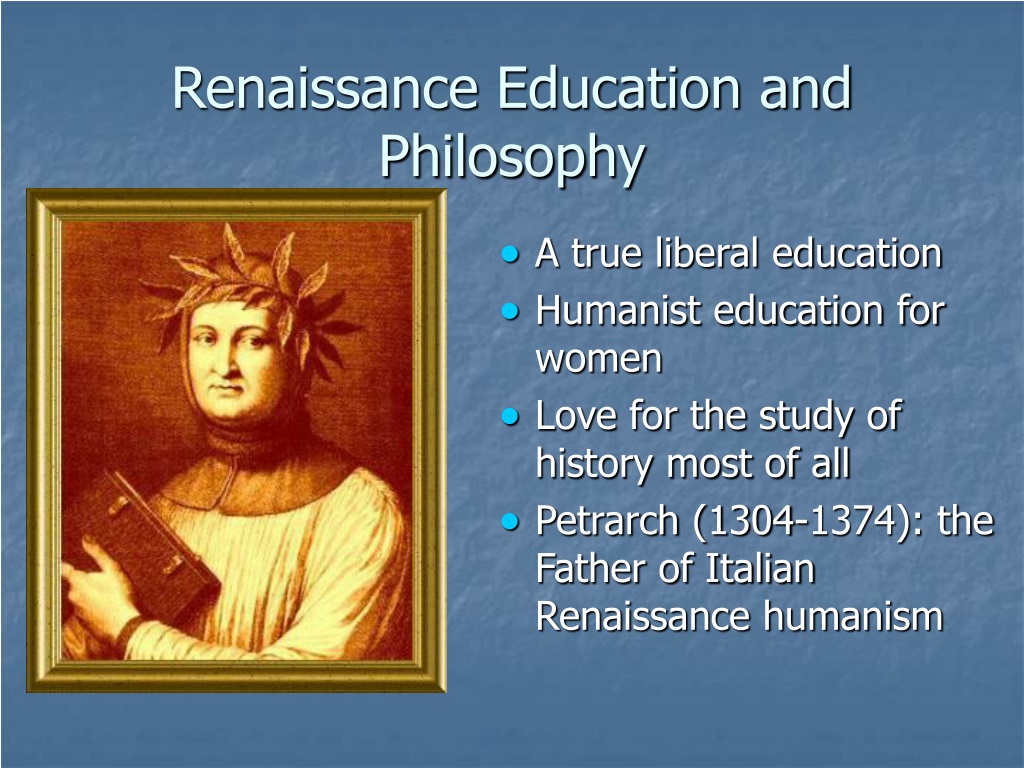
Now, I’m not saying we all need to ditch our STEM degrees and become full-time Renaissance scholars. Far from it! The world needs brilliant scientists, engineers, and doctors. But perhaps, just perhaps, a little bit of the Renaissance spirit, a little more emphasis on the liberal arts, could make us all better at what we do, and more importantly, better at being human.
It’s about creating individuals who are not just skilled, but also wise. Not just knowledgeable, but also curious. Not just productive, but also connected. It’s about building minds that are not only capable of solving the problems of tomorrow, but also of appreciating the beauty and complexity of the world today.
So, next time you’re feeling that mental rut, instead of reaching for another dopamine hit from your phone, consider picking up a classic novel, listening to some Bach, or even just pondering a philosophical question. You might just be surprised at how much richer, more vibrant, and dare I say, more Renaissance, your life can become.
It’s like upgrading from a black-and-white television to 4K ultra HD. Suddenly, everything is clearer, more detailed, and a whole lot more engaging. And who wouldn't want that?