Alright, let's talk about fractions. I know, I know, just the word can make some of us twitch. It’s like suddenly we’re back in the fifth grade, staring at a whiteboard with scribbles that look suspiciously like alien hieroglyphics. But stick with me here, because adding and subtracting fractions isn’t as scary as a surprise pop quiz on a Friday afternoon. In fact, it’s a lot like figuring out how to share that last slice of pizza, or divvying up cookies amongst a gaggle of hungry kids.
Think about it. You’ve got a pizza, right? And it’s cut into, say, 8 slices. If you’re feeling generous and offer your friend half the pizza, you’re basically saying, “Here, take 4/8 of this deliciousness.” Then, if you snag another couple of slices because, let’s be honest, you deserve it, you’ve added 2/8 to your personal stash. Suddenly, you’re doing fraction math without even breaking a sweat. And if you’re feeling particularly magnanimous (or just a little bit guilty), you might even subtract a slice from your own plate and give it to that friend who’s giving you the sad puppy eyes. See? Fractions are all around us, as natural as tripping over your own feet when you’re excited.
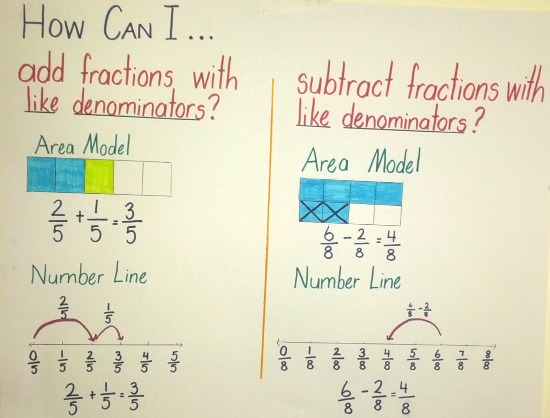
Now, the trick to not getting your fractions in a tangle is having a trusty sidekick. And in the world of math, that sidekick is often called an anchor chart. Imagine it like your culinary cheat sheet for fractions. It’s the recipe card you keep taped to the fridge, the one with the little smudges of sauce on it, but it tells you exactly how to make that perfect spaghetti bolognese. Our fraction anchor chart is going to do the same for adding and subtracting. It’s going to be your visual guide, your friendly reminder, the one that says, “Hey, remember that little thing called a common denominator? It’s your best friend here.”
The Golden Rule: Common Denominators, Your Fraction BFFs
Let’s get down to brass tacks. When you’re adding or subtracting fractions, the absolute, hands-down, most important thing you need is a common denominator. What does that even mean, you ask? Well, imagine you’re trying to compare apples and oranges. You can’t just say, “I have three of these, and you have two of those, so we have five fruits.” It’s not quite the same, is it? Fractions are like that, but with numbers. The bottom number in a fraction, the denominator, tells you how many equal pieces a whole is divided into. The top number, the numerator, tells you how many of those pieces you actually have.
So, if you have 1/2 of a cake and your friend has 1/4 of the same cake, you can’t just add 1 + 1 to get 2, and then say you have 2/2 or 2/4 of the cake. That doesn’t make sense in the real world. It’s like trying to add three cups of flour to two spoonfuls of sugar and expecting a loaf of bread. You need to get them on the same measuring scale, if you will. That’s where the common denominator comes in. It’s like finding a common language for your fractions.
The easiest way to find a common denominator is to find the least common multiple (LCM) of the denominators. Think of it as finding the smallest number that both of your denominators can divide into evenly. For example, if you have 1/2 and 1/4, the denominators are 2 and 4. The LCM of 2 and 4 is 4. See? Easy peasy. So, your 1/2 can be easily converted into 2/4. Now you’re speaking the same fraction language!
This is the part where your anchor chart will be your superhero. It’ll have a little section dedicated to finding that magical common denominator. It might even have some helpful hints, like “try multiplying the denominators together if you’re stuck!” (Though, fair warning, this sometimes gives you a bigger number than you really need, but it’ll still work. Think of it as taking the scenic route when the highway is right there. It gets you there, but it takes a little longer.)
Adding Fractions: Sharing is Caring (and Math!)
Okay, so you’ve got your fractions with their matching denominators. Now what? This is the fun part, the part where you can finally combine things. Imagine you’re at a party, and you’ve got 2/8 of a chocolate bar, and your friend has 3/8 of the same chocolate bar. You want to know how much chocolate you have together. Well, because the denominators are the same (8, meaning both chocolate bars were cut into 8 equal pieces), you can just add the numerators!

So, 2/8 + 3/8 becomes (2+3)/8, which is 5/8. Boom! You’ve just added fractions. It’s as simple as counting how many slices of pizza you’ve pooled together. Your anchor chart will have a clear, concise example of this. It'll probably show you how the numerators just get to hang out and add up, while the denominator chills out, staying the same. It’s like a happy little mathematical family reunion.
Think about it this way: If you have 1/3 of a pie and your sibling has 1/3 of the same pie, you both have thirds. You can easily say, “Hey, we have 2/3 of the pie combined!” The denominator (the size of the pie slice) doesn’t change, but the number of slices you have does. It’s a beautiful, simple concept.
Sometimes, after you add fractions, you might end up with a fraction that can be simplified. This is like tidying up your answer. If you had 4/8 of that chocolate bar, you could say, “Hey, that’s the same as 1/2!” Your anchor chart will likely have a section on simplification, showing you how to find the greatest common factor (GCF) of the numerator and denominator and divide both by it. It’s like turning those 8 tiny pieces into 4 slightly bigger, more manageable pieces, or even further into 2 super-sized slices.
Subtracting Fractions: The Art of Giving Back (or Just Wanting Less)
Subtraction is the flip side of the coin, and thankfully, it works pretty much the same way. You still need those handy-dandy common denominators. Imagine you started with 7/10 of a giant cookie, and you’re feeling generous (or maybe you just can’t eat that much). You decide to give 2/10 of that cookie to your dog, who’s staring at you with those impossibly cute eyes.
So, you have 7/10, and you’re taking away 2/10. Again, because the denominators are the same, you just subtract the numerators! (7-2)/10 = 5/10. Your anchor chart will show this just as clearly as addition. It’ll highlight that the denominator stays put, like a stoic guardian of the fraction’s size, while the numerators do the subtracting dance.

Think about it like this: You have a stack of pancakes, and each pancake is cut into 6 equal parts. You have 5/6 of a pancake to start. Then, you eat 3/6 of it. How much is left? You had 5 parts, and you gobbled up 3 parts, so you have 2 parts left, out of the original 6. That’s 2/6. Simple, right? It’s just about how many pieces you have left after some have disappeared.
Just like with addition, you might need to simplify your answer after subtracting. If you ended up with 4/6 of something, your anchor chart would remind you that this can be simplified to 2/3. It’s like saying, “Instead of these two smaller pieces, I have one bigger piece that’s just as good.”
When Denominators Don't Match: The Conversion Tango
Now, the slightly more involved scenario. What happens when you need to add or subtract fractions that don’t have the same denominator? This is where the conversion tango comes in. Remember our pizza example from the beginning? If you have 1/2 of a pizza and your friend has 1/4 of a different pizza (but let’s assume they’re the same size for math’s sake!), you can’t just add 1 + 1.
This is where your anchor chart will be your absolute savior. It will guide you through the process of finding that least common denominator (LCD). You’ll find the LCM of the two denominators. Let’s say you have 1/3 and 1/6. The LCM of 3 and 6 is 6. So, you need to convert 1/3 into an equivalent fraction with a denominator of 6. How do you do that? You ask yourself, “What do I multiply 3 by to get 6?” The answer is 2.
And here’s the golden rule of conversion: Whatever you do to the denominator, you must do to the numerator. It’s like a mathematical pact. If you multiply the denominator by 2, you have to multiply the numerator by 2 as well. So, 1/3 becomes (1 * 2) / (3 * 2), which is 2/6. Now you have 2/6 and 1/6. See? Now they’re speaking the same language!

Your anchor chart will have a step-by-step breakdown of this. It’ll probably show you the multiplication factor, like “x2” above and below the fraction, visually demonstrating the transformation. It's like giving one of your fractions a makeover so it can finally mingle with the other one properly.
Once you’ve done this conversion, the rest is a piece of cake (or, well, a piece of pie). If you were adding 1/3 + 1/6, you’d now be adding 2/6 + 1/6, which equals 3/6. And that, my friends, can be simplified to 1/2. You just figured out how much pie you have together!
Mixed Numbers: When Fractions Get a Little Too Excited
Sometimes, fractions show up as mixed numbers. These are those numbers that have a whole number and a fraction attached, like 2 1/2. Think of it as having two whole pizzas and then half of another. It’s a perfectly normal way to describe quantities, like saying “I need two and a half cups of flour.”
When you’re adding or subtracting mixed numbers, there are a couple of ways to tackle it. One way is to keep the whole numbers and fractions separate, do the operation on the fractions first (making sure they have common denominators, of course!), and then combine the results. Your anchor chart might offer this as a “simpler” method if the fractions are easy to work with.
The other, often more robust, method is to convert those mixed numbers into improper fractions. An improper fraction is one where the numerator is bigger than or equal to the denominator (like 5/2). To convert 2 1/2 into an improper fraction, you multiply the whole number (2) by the denominator (2) and add the numerator (1). So, (2 * 2) + 1 = 5. The denominator stays the same, so you get 5/2.

Your anchor chart will have a clear diagram for this conversion. It might even use a little mnemonic device, like “multiply, add, keep the bottom the same.” Once everything is in improper fraction form, you can add or subtract them using the same common denominator rules we’ve already discussed. This method is often preferred because it helps avoid those tricky borrowing situations you can sometimes get into with subtraction of mixed numbers.
After you’ve done your adding or subtracting with improper fractions, you might need to convert your answer back into a mixed number. If you ended up with 7/2, your anchor chart will show you how to divide 7 by 2. You get 3 with a remainder of 1. That 3 is your whole number, and the remainder (1) becomes your new numerator, with the original denominator (2) staying put. So, 7/2 becomes 3 1/2. It’s like unpacking your fractions into their neatest, most understandable form.
The Anchor Chart: Your Brain's Best Friend for Fractions
So, why all this fuss about an anchor chart? Because it’s your visual anchor in the sometimes turbulent seas of fraction arithmetic. It’s not about memorizing endless rules; it’s about having a reference that makes the process clear and accessible. Think of it as a well-organized toolbox. When you need to fix something, you don’t have to rummage through a pile of junk; you know exactly where to find the wrench or the screwdriver.
Your anchor chart will have all the key steps laid out:
- The need for a common denominator. (The big, bold, flashing neon sign!)
- How to find that common denominator (LCM). (Your map to the treasure.)
- How to convert fractions to equivalent ones. (The magic trick to make denominators match.)
- Adding numerators when denominators are the same. (The easy part!)
- Subtracting numerators when denominators are the same. (The other easy part!)
- Simplifying fractions. (Making your answers neat and tidy.)
- Dealing with mixed numbers. (Converting to improper fractions and back.)
It’s the kind of thing you can stick on your fridge, tape to your locker, or even keep in your binder. When you’re faced with a fraction problem, you can glance at it, get a quick refresher, and get back to solving. It takes the panic out of the process and replaces it with a sense of calm competence.
So, don't be intimidated by fractions. They're just a way of talking about parts of a whole. And with a little help from your trusty anchor chart, you’ll be adding and subtracting them like a pro in no time. You'll be sharing pizza, dividing cakes, and generally conquering the world of fractions with a smile. And who knows, maybe you'll even start to appreciate the elegant logic behind it all. Or at least, you'll be able to confidently help your kids with their homework without needing a calculator and a strong cup of coffee. And in today's world, that's practically a superpower.